There is something almost comically ironic about the history of the plastic shopping bag.
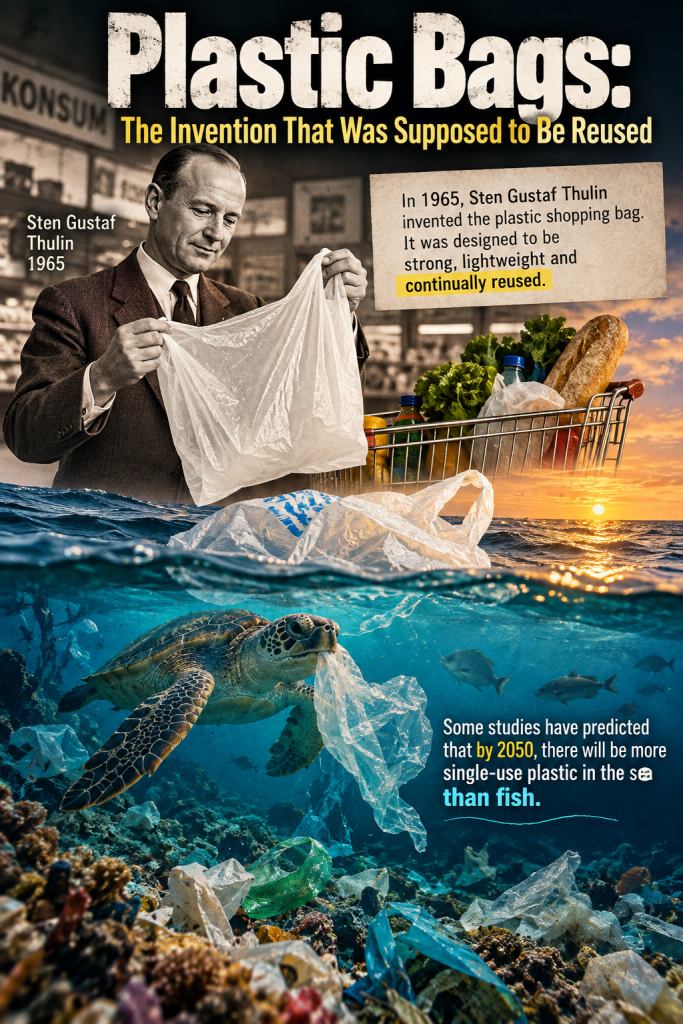
In 1965, Swedish engineer Sten Gustaf Thulin developed the one-piece polyethylene shopping bag that would eventually become one of the most recognizable objects in modern shopping. His design was lightweight, strong, inexpensive, and easy to manufacture. It quickly began replacing paper and cloth bags in Europe.
And apparently, that was where things went sideways.
Because the plastic shopping bag wasn’t originally envisioned as a one-trip wonder.
Thulin’s design was durable. According to accounts of his thinking, the bag was intended to be reused rather than immediately thrown away. There was even a practical reason behind the invention: a lightweight plastic bag could reduce reliance on paper bags and the trees needed to make them.
That sounds pretty reasonable.
Reuse the bag.
Carry it again.
Maybe put something else in it.
Eventually use it until it finally gives up the ghost.
Simple.
Except humans got involved.
And humans are exceptionally good at turning a reusable object into a disposable object.
Welcome to the Age of “Do You Want a Bag?”
Eventually, the plastic shopping bag became so cheap and convenient that its intended reuse became almost irrelevant.
You’d go to the store.
Buy your groceries.
Get a plastic bag.
Drive home.
Unload the groceries.
And then the bag would enter the mysterious second life of household plastic bags.
Maybe it became a trash-can liner.
Maybe it carried something else.
Maybe it was shoved underneath the kitchen sink with 47 of its closest relatives.
Maybe it was used to carry dog poop outside.
And eventually, one day, somebody decided they had enough bags.
Into the trash it went.
That’s the strange thing about plastic.
It can be incredibly useful for minutes and incredibly persistent for decades.
We created something that is excellent at surviving and then built a culture around throwing it away.
That’s not exactly a brilliant combination.
The Bag That Wouldn’t Die
Plastic itself isn’t automatically evil.
That’s an important distinction.
Plastic has enormous practical value. It’s lightweight, durable, waterproof, inexpensive, and useful in everything from medical equipment to food packaging to construction. The problem is what happens when plastic becomes waste and escapes proper waste-management systems. Our World in Data estimates that roughly 0.5% of global plastic waste ultimately reaches the ocean, while emphasizing that the overwhelming environmental problem comes from mismanaged waste and leakage.
And once plastic gets into the environment, it doesn’t simply disappear.
It breaks down into smaller and smaller pieces.
Eventually we get microplastics and even smaller particles.
The bag doesn’t necessarily cease to exist.
It just becomes harder to see.
That’s arguably worse.
A plastic bag floating on the surface of the ocean is easy to understand.
A microscopic piece of plastic circulating through an ecosystem is a much harder problem to wrap your head around.
And Then There Is the Ocean
Marine life didn’t ask for plastic.
Yet plastic has become a major component of marine pollution.
The United Nations Environment Programme reports that plastics account for at least 85% of marine litter and identifies plastic pollution as a significant threat to ecosystems and wildlife.
Sea turtles can mistake floating plastic bags for jellyfish.
Seabirds can consume plastic.
Marine mammals and other animals can become entangled in discarded plastic.
Plastic can also break apart into smaller particles that move through marine ecosystems.
That’s where the story gets considerably less funny.
A bag that was convenient for us can become a genuine hazard for something living in the ocean.
The turtle doesn’t know it was supposed to be reusable.
The fish doesn’t know somebody paid seven cents for it.
The seabird doesn’t care whether it came from the grocery store, a convenience store, or somebody’s basement.
It’s just plastic.
The Famous 2050 Prediction
You’ve probably heard the line:
By 2050, there could be more plastic in the ocean than fish.
It’s an incredible headline.
It’s also important to understand what it actually means.
The World Economic Forum and Ellen MacArthur Foundation publicized a 2016 projection that, under the assumptions and trajectory used in that analysis, the oceans could contain more plastic than fish by weight by 2050.
But that shouldn’t be presented as a guaranteed prediction.
The amount of plastic in the ocean and the future amount of fish are both difficult to measure and project. Some scientific assessments have specifically cautioned that the “more plastic than fish” statement is uncertain and should not be treated as an established future fact.
The bigger point doesn’t actually require the dramatic headline.
We’re putting enormous quantities of plastic into the environment.
That’s already a problem.
We don’t need to wait until 2050 to discover whether the fish have officially lost the numbers game.
The Great Plastic Bag Experiment
What fascinates me about the plastic bag is how perfectly it represents a larger problem.
The technology wasn’t necessarily the problem.
The original idea wasn’t necessarily the problem.
The problem was what happened after we got the invention into the hands of billions of people.
We took something designed to be durable and reusable and turned it into something disposable.
That’s quite an accomplishment.
It’s almost like inventing a coffee mug and immediately deciding the correct way to use it is to throw it away after every sip.
“Would you like another mug?”
“No thanks. I’ll take 14.”
There is something deeply human about that.
We love convenience.
If something is cheap enough, light enough, and easy enough, we tend to stop thinking about what happens to it after we’re finished.
The checkout counter is the beginning of the transaction.
It isn’t necessarily the end of the story.
So What Do We Do With the Bag?
Maybe the answer isn’t complicated.
Use fewer disposable bags.
Reuse the ones we have.
Recycle where appropriate.
Dispose of them properly.
And think about what we’re actually buying when somebody hands us something that appears to be free.
Because the plastic bag isn’t really free.
Somebody manufactured it.
Somebody transported it.
Somebody eventually has to manage it as waste.
And sometimes, if things go badly, an animal ends up paying the bill.
The funny thing is that Sten Gustaf Thulin’s original idea wasn’t particularly complicated.
Make a strong bag.
Use it again.
And again.
And again.
Somewhere along the way, we forgot the second part.
Maybe the future doesn’t require us to eliminate every piece of plastic from our lives.
Maybe it requires us to remember something that was apparently understood back in 1965:
Just because something is disposable doesn’t mean it has to be used that way.
And maybe the next time somebody asks, “Paper or plastic?” we should at least remember that the plastic bag has a history.
It was supposed to be reused.
We just got really good at forgetting.


Leave a Reply