They’re calling for a high of 100°F today, and it’s already pushing 95°F—the kind of heat that presses against the windows and makes the air feel thick and still. Definitely an air conditioning kind of day.
Morning Routine
This morning I cleaned up a good amount of flower for my sativa stash, the sharp, earthy scent lingering as I worked. Now everything’s stocked, neatly arranged, and within reach. There’s something satisfying about that quiet order—like setting the tone for a long, slow day.
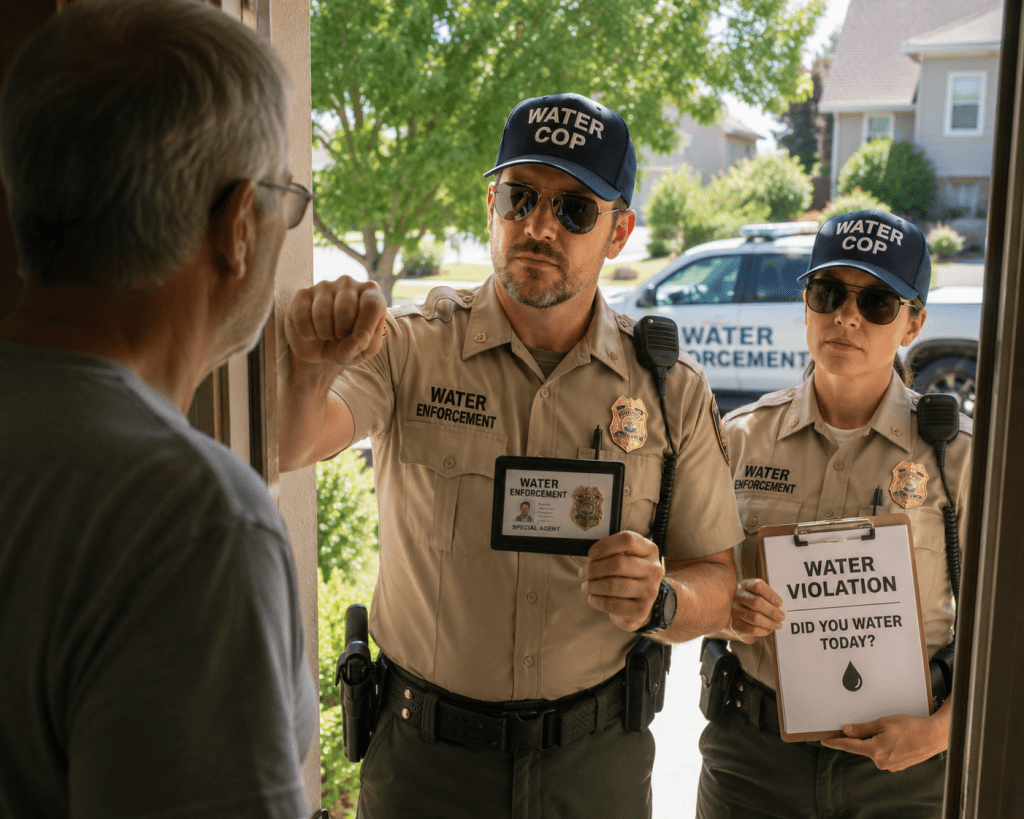
Before the heat fully settled in, I gave the front yard a 20-minute watering, the hose hissing as the soil soaked it up. The grass darkened just enough to look alive again. Hopefully it holds until tomorrow night—every drop counts in weather like this, and I don’t need the water cops knocking on my door or emailing me.
Home Comfort
I also washed all my bedding—comforter, pillows, and sheets—so everything is fresh and cool to the touch. That clean, soft smell is hard to beat, especially knowing I’ll be sinking into it later. I just wish I had someone to share it with.
Evening Plan
Now the plan is simple: stay inside, stay cool, and let the AC hum in the background while I ride out the heat. 🌞❄️
When you’ve been around cannabis long enough, you learn that consistency is worth its weight in gold.
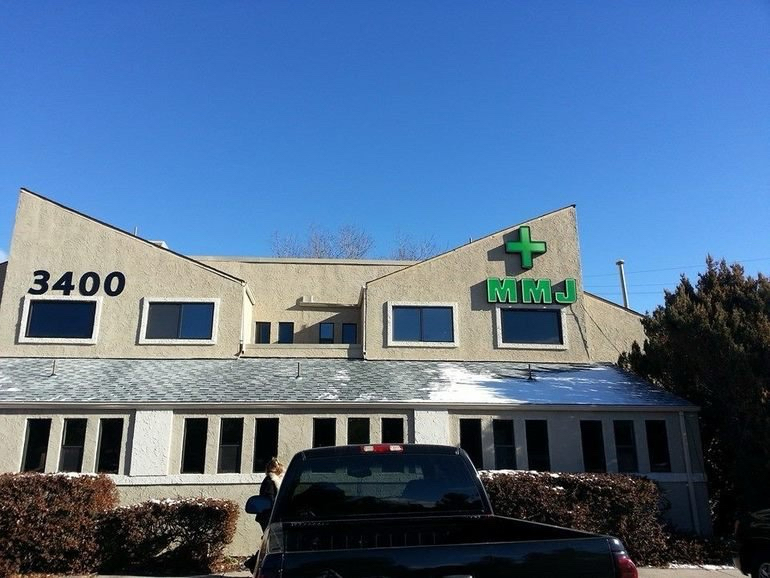
I’ve visited plenty of dispensaries over the years, but one place has continued to earn my business: Green Cross of Cherry Creek.
This isn’t a paid endorsement. It’s simply my experience as a longtime customer who appreciates quality products, knowledgeable budtenders, and a dispensary that has stood the test of time.
A Colorado Original
Green Cross of Cherry Creek has been serving Colorado cannabis consumers for well over a decade. In an industry that’s constantly evolving, that kind of longevity doesn’t happen by accident.
They’re a licensed Colorado dispensary offering both medical and recreational cannabis, with a wide selection that includes:
● Premium flower
● Vape cartridges
● Concentrates
● Edibles
● Topicals
● Pre-rolls
● Accessories
Whether you’re looking for a budget-friendly eighth or something special for the weekend, there’s usually a good selection available.
Customer Service Still Matters
One of the biggest reasons I keep coming back is the staff.
I’ve always found them to be approachable, knowledgeable, and willing to answer questions without making customers feel rushed. That kind of service makes a difference, especially for people who are still learning about cannabis or trying new products.
Why They’ve Earned My Trust
Trust isn’t built during one visit.
It’s built over years of consistent experiences.
For me, Green Cross has delivered:
● Reliable quality
● Competitive pricing
● Friendly customer service
● An established reputation in Colorado’s cannabis community
Those are the reasons they’ve remained one of my preferred dispensaries.
My Final Take
Colorado has no shortage of dispensaries.
The ones that survive year after year usually do so because they’ve built lasting relationships with their customers.
Green Cross of Cherry Creek has earned my respect through consistency, professionalism, and a commitment to serving the cannabis community.
If you’re exploring dispensaries in the Denver area, they’re certainly worth considering.
About the Author
BenJammin is the creator of GravitySucksBigTime.com, where he writes about life after a traumatic brain injury and stroke, disability, cannabis, recovery, home projects, and finding humor in everyday life.
There’s something satisfying about ending an errand on your own terms instead of squeezing in “just one more stop.” A good lunch at home beats fast food any day, especially when you’re already looking forward to relaxing. It gave me a chance to recharge, appreciate that my body had cooperated, and enjoy the small victory of getting out, getting what I needed, and making it home without pain stealing the spotlight.
I kept it simple and had a basic Lunchable for lunch—nothing fancy, but it hit the spot. Sometimes that’s all you need: something easy, familiar, and quick so you can settle in and enjoy the moment without overdoing it.
And honestly, after all that, a nap would be proper. When you’re still healing, rest isn’t optional—it’s part of the process. Sometimes the best way to cap off a successful outing is to lean into that calm, let your body recover, and enjoy the quiet. Today, lunch at home wasn’t just a meal—it was the reward for a trip that went exactly the way I’d hoped, and the perfect lead-in to a well-earned nap.
This morning started with a workout, and I’m calling that a victory. I finished feeling pretty good, even if my leg is still barking at me. It’s not completely on board with the plan yet, but I got the work done anyway.
I’ll take that as a win.
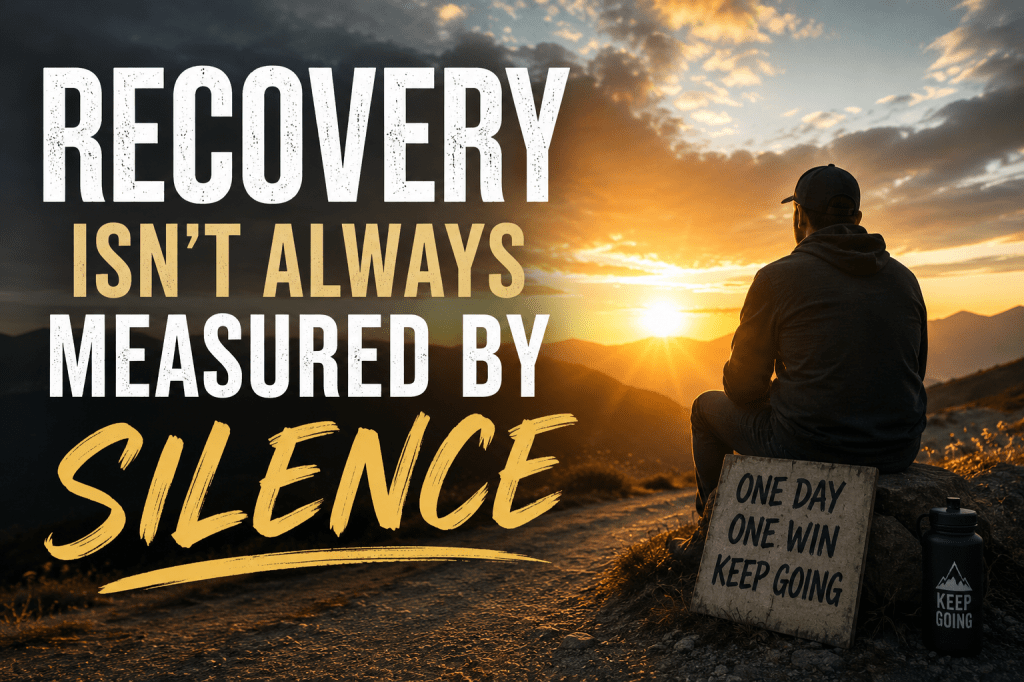
Recovery isn’t always measured by silence. Sometimes it’s measured by showing up, putting in the effort, and proving to yourself that the engine still starts, even if one of the tires keeps complaining. Today was one of those days.
The day got rolling early again. I had the backyard sprinklers going by 6:00 AM, giving the grass another drink before the Colorado sun could take over.
After that, I cleaned the bathroom to get the house ready for our incoming guests. It always feels good to cross a job like that off the list.
I also put the basement door back in place. The only thing left is reinstalling the left-side door strip, but it’s back where it belongs and looking much better.
Later, Claire, Dakota, and I made a trip to Kohl’s. We picked out a new shower rug, shower curtain, and liner to freshen up the bathroom. Once we got home, I did a little more scrubbing to get everything looking just right.
One thing definitely didn’t make the favorites list: Dakota’s Dr. Squatch soap. I don’t care for the scent at all. To me, that stuff flat-out stinks. It also seemed to leave more residue than I’m used to, so cleaning the shower wasn’t exactly a glowing endorsement. Dakota can have it. I’ll happily stick with my own soap.
By the end of the day, the backyard got its water, the bathroom got a makeover, a few home projects moved forward, and we enjoyed a family trip to Kohl’s. Not every day has to be exciting. Sometimes checking things off the list and sharing a few laughs is more than enough.
Some days are packed with big accomplishments. Other days are stitched together with little victories, unexpected detours, and stories you couldn’t make up if you tried.
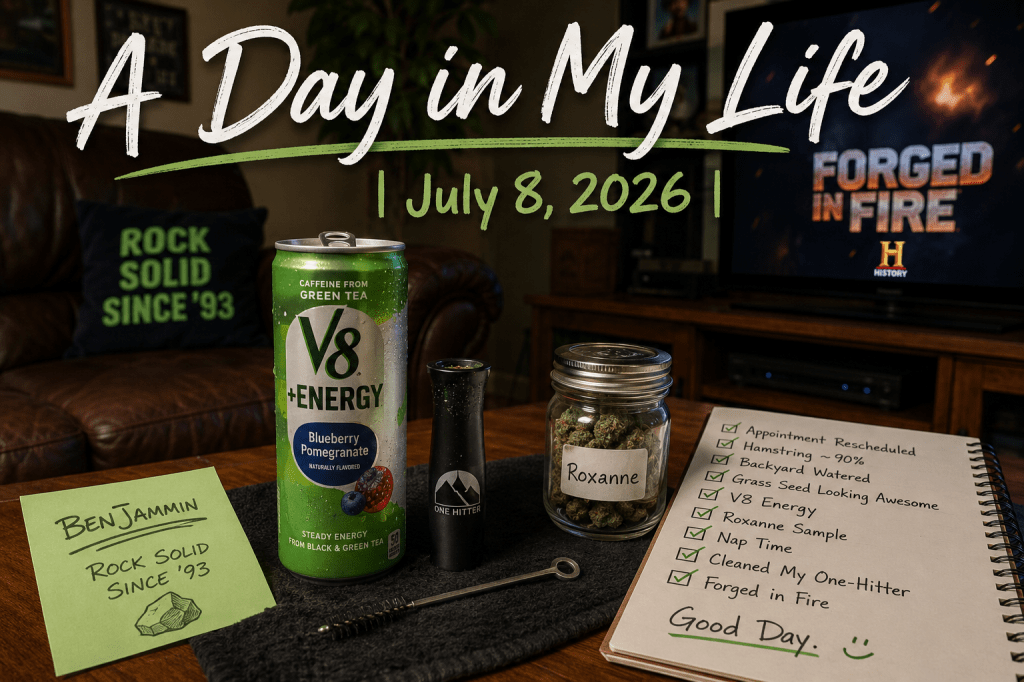
I started the day by rescheduling an appointment online through a text message. Pretty cool, actually. They’ll be here Friday to replace the button that decided to call it quits last night.
Even better, my left hamstring woke up feeling about 90%. After the last couple of weeks, that felt like a major milestone. I also got the backyard grass watered before the heat rolled in. The grass seed is looking pretty awesome after a good soaking yesterday and another drink today. It’s satisfying to see all that work starting to pay off.
A V8 Energy helped keep the morning rolling, although by the time the can was nearly empty, I was feeling like I’d already put in a full day’s work… and it wasn’t even 9:00 a.m.
I decided to sample a little of my Roxanne strain before settling in for a well-earned nap. Sometimes the best thing you can do for healing is simply get out of your own way and let your body recharge.
The nap did its job.
Of course, waking up somehow led to cleaning my one-hitter, because apparently that’s how my brain defines “taking it easy.” The moment I cracked it open, the old resin reminded me it had been waiting for some attention. During the cleaning, I managed to coat my left hand with a giant glob of sticky resin. It took a determined round of soap and scrubbing to win that battle, but eventually the tar surrendered.
With clean hands, a clean one-hitter, and my dignity mostly intact, I wrapped up the afternoon watching Forged in Fire on the HISTORY Channel.
Looking back, it was a good day. My hamstring is healing, the backyard is getting greener, the one-hitter is clean again, and I even squeezed in a restorative nap.
Some days are packed with big accomplishments. Other days are stitched together with little victories, unexpected detours, and stories you couldn’t make up if you tried.
I started the day by rescheduling an appointment online through a text message. Pretty cool, actually. They’ll be here Friday to replace the button that decided to call it quits last night.
Even better, my left hamstring woke up feeling about 90%. After the last couple of weeks, that felt like a major milestone. I also got the backyard grass watered before the heat rolled in. The grass seed is looking pretty awesome after a good soaking yesterday and another drink today. It’s satisfying to see all that work starting to pay off.
A V8 Energy helped keep the morning rolling, although by the time the can was nearly empty, I was feeling like I’d already put in a full day’s work… and it wasn’t even 9:00 a.m.
I decided to sample a little of my Roxanne strain before settling in for a well-earned nap. Sometimes the best thing you can do for healing is simply get out of your own way and let your body recharge.
The nap did its job.
Of course, waking up somehow led to cleaning my one-hitter, because apparently that’s how my brain defines “taking it easy.” The moment I cracked it open, the old resin reminded me it had been waiting for some attention. During the cleaning, I managed to coat my left hand with a giant glob of sticky resin. It took a determined round of soap and scrubbing to win that battle, but eventually the tar surrendered.
With clean hands, a clean one-hitter, and my dignity mostly intact, I wrapped up the afternoon watching Forged in Fire on the HISTORY Channel.
Looking back, it was a good day. My hamstring is healing, the backyard is getting greener, the one-hitter is clean again, and I even squeezed in a restorative nap.
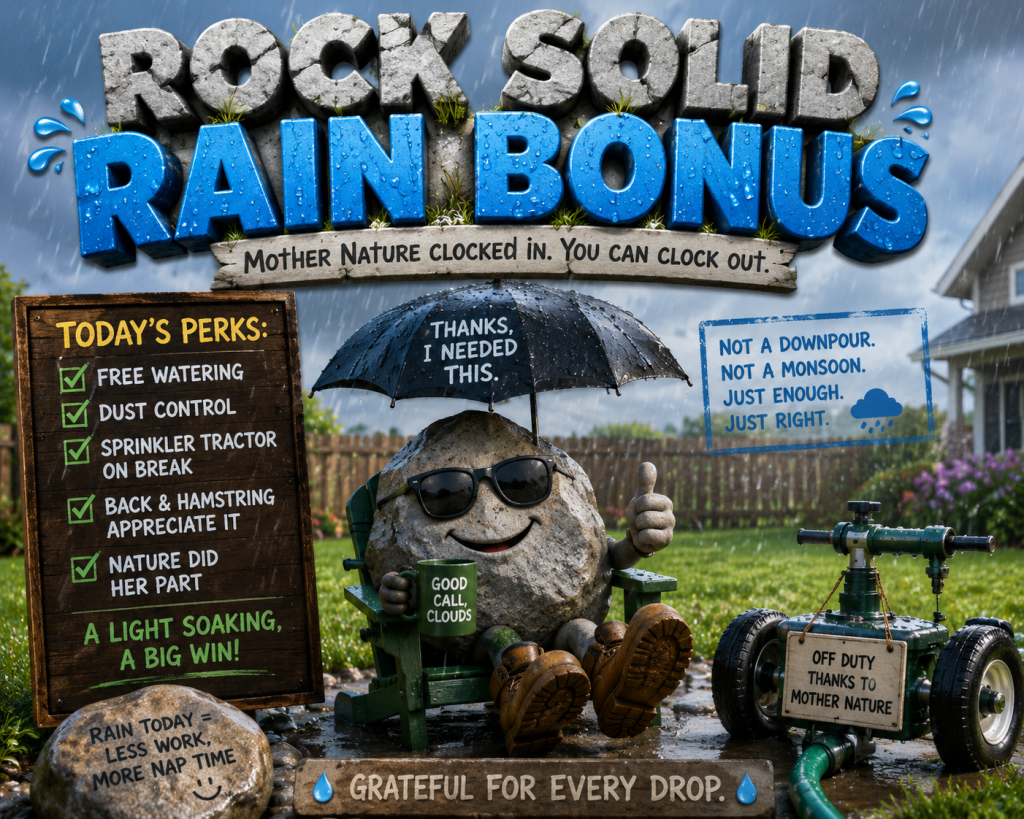
A light soaking isn’t just about how much rain fell. It’s about what it means after the kind of morning you had.
You were out at dawn, irrigating half the backyard. You wrestled a sprinkler tractor that reminded your hamstring who’s boss. Then, instead of the sky staying stubbornly blue, you heard those first raindrops on the roof.
It’s almost as if the weather looked over the fence and said, “You’ve carried enough buckets today. I’ll take the next shift.”
Sure, it wasn’t a gully washer. But it was a little relief at exactly the right moment.
Around your place, I’d call that a Rock Solid Rain Bonus. Not enough to flood the gutters, but enough to make the grass smile, the dust settle, and your back think, “Maybe we’re done hauling things for today.”
Sometimes the best rain isn’t the storm that makes the news. It’s the one that quietly whispers, “You can rest now.”
Version 2
The more I think about it, the more I appreciate it.
A light soaking isn’t just about the amount of rain that falls. It’s about what it means after a morning like mine.
I was out before sunrise watering half the backyard, then wrestled the sprinkler tractor around until my hamstring reminded me it still has opinions. Just when I was wondering if the effort was worth it, I heard the first raindrops tapping on the roof.
It wasn’t a downpour, and it won’t make the evening news, but it was enough. Enough to give the lawn a helping hand. Enough to settle the dust. Enough to let me park the sprinkler tractor and give my back and hamstring a well-earned break.
Sometimes the best rain isn’t the storm that soaks everything. It’s the gentle shower that arrives at exactly the right moment and quietly says, “I’ve got it from here.”
Version three
Before I could even finish my morning coffee, I was out in the backyard playing tug-of-war with the sprinkler tractor. Whoever designed that thing clearly skipped the chapter on ergonomics. My hamstring has since filed a formal complaint, my back signed it as a witness, and both are demanding hazard pay.
Then, just as I was wondering whether I should move the sprinkler again or simply negotiate with the grass, I heard it.
Tap… tap… tap…
Rain.
Not a thunderstorm. Not a monsoon. More like Mother Nature cracking open a water bottle and saying, “Here, don’t spend it all in one place.”
I’ll take it.
The lawn got a free drink, the dust settled down, and the sprinkler tractor was officially relieved of duty for the afternoon. Around here, that’s what we call a successful labor negotiation.
Would I have preferred a good old-fashioned Colorado gully washer? Absolutely.
But after wrestling yard equipment before breakfast, even a light soaking feels like the universe saying, “You’ve done enough. Clock out before your hamstring starts writing letters to management.”
Dakota signed a lease—and I got the grand tour of his new apartment at the Castle Rock Promenade.
Standing there and walking through the place made it official.
It’s real.
As a parent, there are moments that sneak up on you. One day you’re helping your kid figure out the next step, and the next you’re standing in their very own apartment, realizing they’re building a life of their own.
It’s exciting.
It’s a little surreal.
And yes…there’s a little bit of “Where did the years go?” mixed in there.
I’m proud of Dakota for taking this step. Signing a lease is more than getting an apartment. It’s a commitment, a responsibility, and another chapter of becoming independent.
Congratulations, Dakota!
Here’s to new beginnings, new memories, and a place to call your own.
Some days don’t ask for permission. They just show up with a wrench.
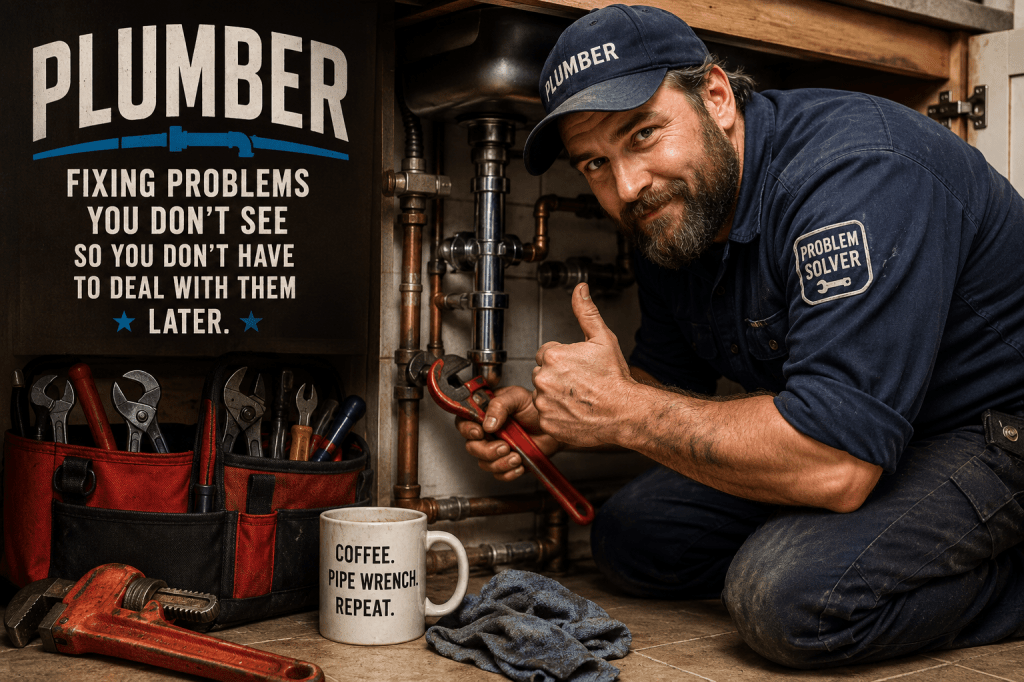
The morning started with the plumbing company arriving to replace a broken water shutoff valve. It looked like a straightforward repair… until it wasn’t.
As the work progressed, the real problem revealed itself. The valve wasn’t the only issue. About a foot below the valve assembly, a soldered connection also needed repair. That’s the kind of surprise no homeowner enjoys, but I’d rather have it discovered now than after the washer is hooked up and water is flowing.
With the plumbing repaired properly, I contacted Home Depot and rescheduled the washer installation for July 6. It’s not the finish line I expected today, but at least the project is moving forward instead of standing still.
Owning a home has a way of reminding you that every “quick fix” has the potential to become an adventure. Today’s lesson? Sometimes you have to repair the foundation before you can enjoy the upgrade.
Progress isn’t always measured by what gets installed. Sometimes it’s measured by what gets fixed first.
Today’s Scorecard
✅ Broken valve replaced
✅ Hidden solder connection identified and repaired
✅ Washer installation rescheduled for July 6
✅ Another chapter in the never-ending Homeowner Chronicles
Gravity still sucks… but at least the plumbing doesn’t leak anymore.
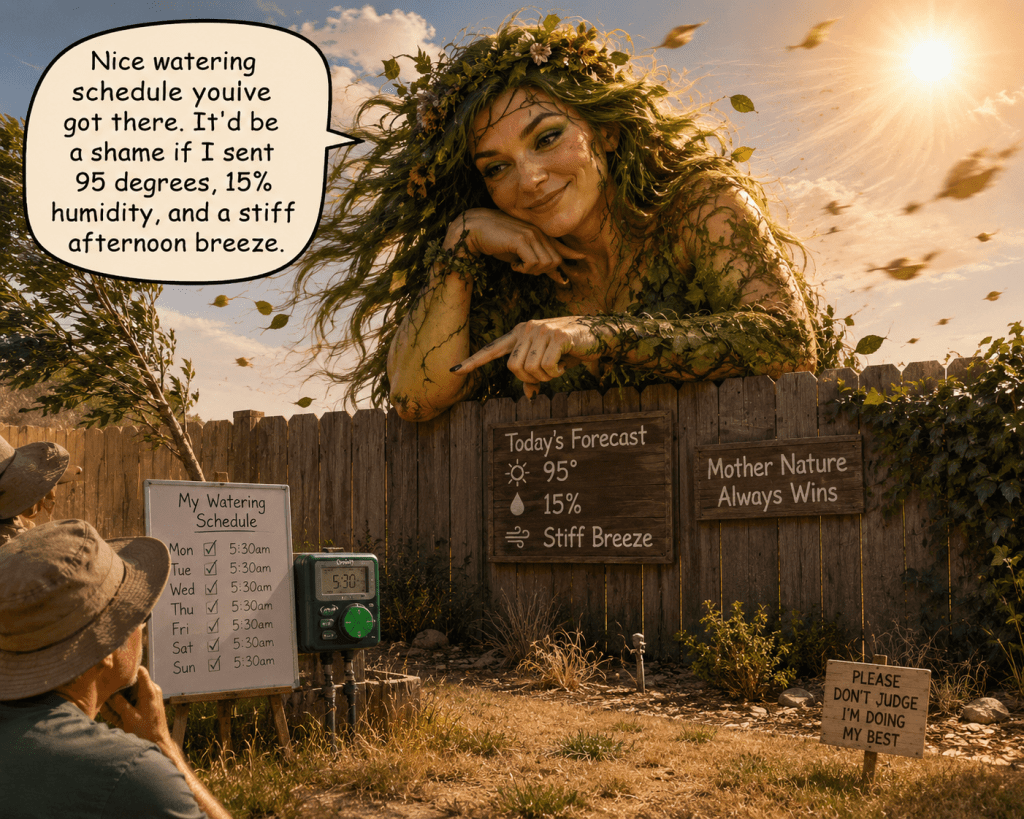
I have officially reached the point where I think Mother Nature has been studying my watering schedule.
Every time I think I’ve got the lawn figured out, she changes the rules.
One day it’s 95 degrees.
The humidity drops to 15%.
Then comes that relentless afternoon breeze that seems determined to pull every last drop of moisture out of the soil.
It feels like she’s leaning over my backyard fence with a grin, saying:
“Nice watering schedule you’ve got there. It’d be a shame if I sent 95 degrees, 15% humidity, and a stiff afternoon breeze.”
This season has been a battle.
I’ve adjusted my Orbit watering system, watched the forecasts, watered before sunrise, reseeded bare spots, mowed to keep the HOA happy, and crossed my fingers every time a storm cloud appeared on the radar.
Some days the lawn looks like it’s making a comeback.
Other days it looks like Mother Nature won another round.
The truth is, Colorado summers don’t hand out participation trophies. Between the blazing sun, low humidity, and nonstop wind, keeping a lawn healthy can feel like a full-time job.
But I’m not waving the white flag.
The plan now is simple:
Keep the healthy grass alive.
Give the struggling areas a fighting chance.
Remember that fall is often Colorado’s real lawn-growing season.
If you’ve been fighting the same battle this year, you’re not alone. Sometimes the scoreboard favors Mother Nature.
For now.
I’ll be back in the yard tomorrow morning, coffee in one hand, hose timer in the other, ready for the next inning.
Some days start with a plan. Other days start with an idea that keeps bouncing around your head until you either do it or talk yourself out of it.
Today’s idea was a familiar one: a possible morning bud run to Green Cross in Cherry Creek.
I’ve been making that trip for about seven years. That’s long enough to know the route, the rhythms of Denver traffic, and whether the drive is going to be worth it. Living in Castle Rock means it isn’t exactly around the corner, and most days the distance feels longer than the map suggests.
Still, every now and then the stars line up.
Under perfect driving conditions, I’ve made the trip door to door in about an hour. It doesn’t happen often, but when traffic cooperates, the Mini Cooper seems to know the way.
Part of the attraction is the famous “$7 real meal deal.” Finding quality flower at a good price never gets old. A bargain always feels a little sweeter when it comes after years of knowing what works for you.
The funniest part of the day had nothing to do with cannabis.
My phone’s spellcheck decided to introduce someone named “Brian” into the conversation. There is no Brian. I have no idea who Brian is. Apparently, my keyboard thought he deserved a speaking role anyway. Technology keeps life interesting.
Whether tomorrow becomes a dispensary day or not, today’s conversation reminded me that routines have value. Seven years of visiting the same place has taught me what I like, what I’m looking for, and when the drive simply isn’t worth making.
Sometimes the journey matters.
Sometimes the destination matters.
And sometimes the biggest story of the day is wondering who invited Brian. :::writing
If you’d like, I can also add your usual “Today’s Wins,” “Looking Ahead,” and “BenJammin’s Take” sections to keep it consistent with your other journal entries.
Indica, keeper of calmer skies, Painting twilight behind tired eyes. You ask no tribute from the weary soul, Only the chance to become whole.
You know the language mountains speak When granite chooses not to compete With every wind that begs to roar. You simply wait, and nothing more.
You gather daylight by its fraying seams, Mending the hems of broken dreams. You fold the hours with patient hands, Like an old quilt stitched from quieter lands.
The porch grows wider in your care. The crickets find their evening prayer. Coffee becomes memory. Tea becomes company. Silence becomes enough.
You are not the night.
You are the lantern hanging from its porch.
Not forgetfulness.
Remembrance.
The kind that recalls a father’s laugh, A faithful dog asleep at your feet, The smell of rain on thirsty earth, The first star brave enough to appear.
Storms still exist.
You never promised otherwise.
But beneath your watch, their thunder drifts farther away, Until even sorrow speaks in a gentler voice.
Indica, keeper of calmer skies, Painting twilight behind tired eyes.
When tomorrow arrives with its pockets full of noise, Its sharp corners and hurried clocks,
Leave me one corner of evening, One steady chair, One patient breeze, One sky you’ve faithfully kept,
The day got off to a great start with a good shower. Sometimes that’s all it takes to feel human again before tackling the day.
After getting cleaned up, I headed outside for a watering session in the yard. The lawn got its turn, and everything was looking pretty good when I finished.
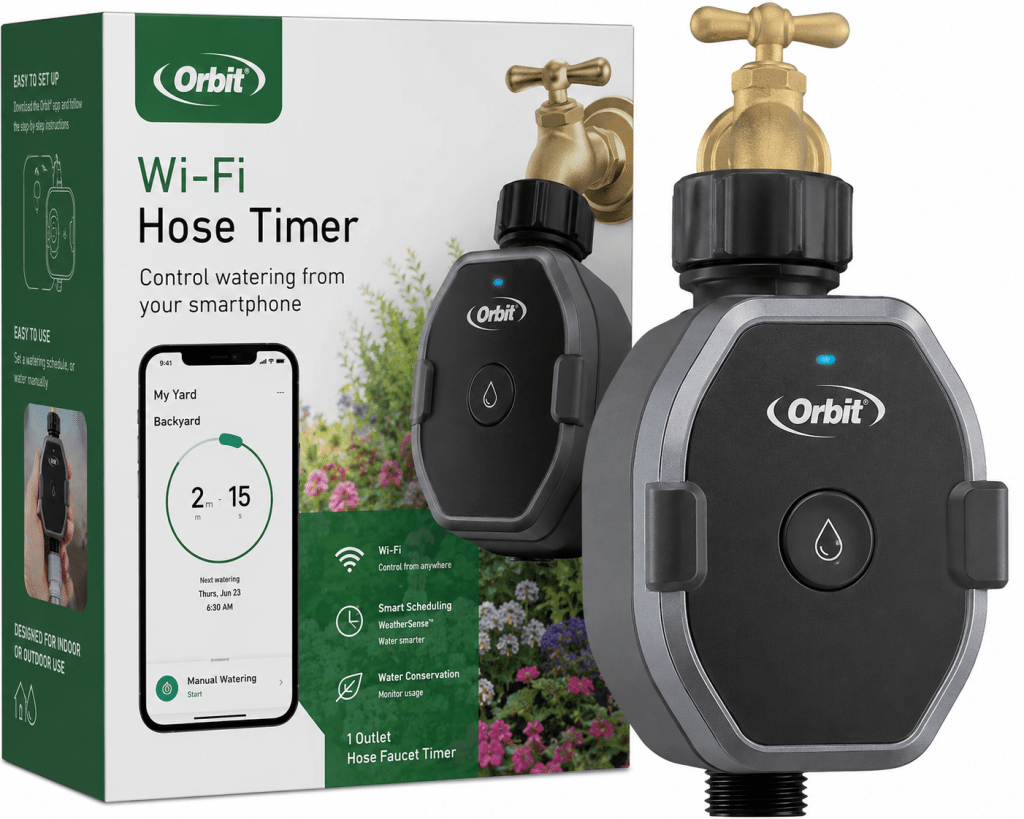
I also took another step toward modernizing my watering setup. I jumped onto Amazon and ordered two Orbit Wi-Fi hose timers. Amazon had a deal where buying two cost the same as buying one, so that was an easy decision.
Claire was ready to get moving after our long day yesterday, so she was encouraging me to hurry up and finish the order. Mission accomplished.
The package is supposed to arrive by 6:00 p.m., which gives me plenty of time to get everything installed and tested. Since I already have an Orbit Hub, setup should be a complete no-brainer. Once they’re paired, I’ll be able to control my sprinklers and hoses right from my phone.
If everything goes according to plan, the new watering system will officially go live in two days when my regular watering schedule starts. It’s pretty amazing how far this technology has come. Instead of dragging hoses around and watching the clock, the Orbit system will handle the schedule while I focus on enjoying the yard.
I’ll post an update once everything is installed and running. Sometimes progress comes in big moments. Other times, it’s a hot shower, a watered lawn, and a little technology making life easier.
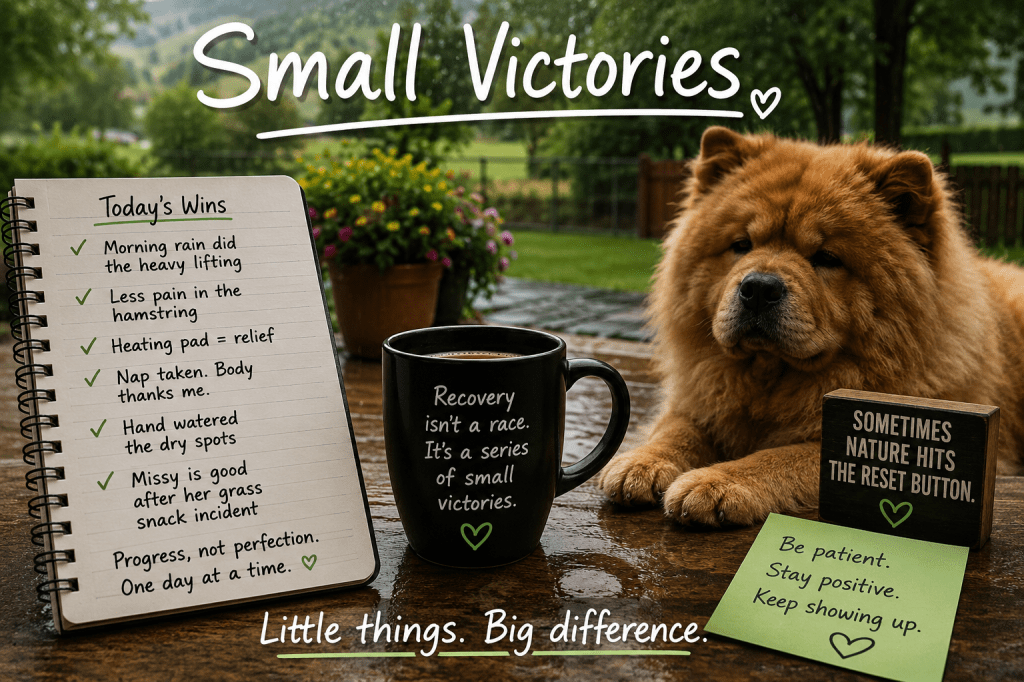
Today wasn’t about big accomplishments. It was about recognizing the small signs that recovery is moving in the right direction.
A welcome overnight downpour gave the backyard a much-needed drink, allowing me to postpone most of the watering until later in the day. I still hand-watered a few dry spots, but Mother Nature handled most of the heavy lifting.
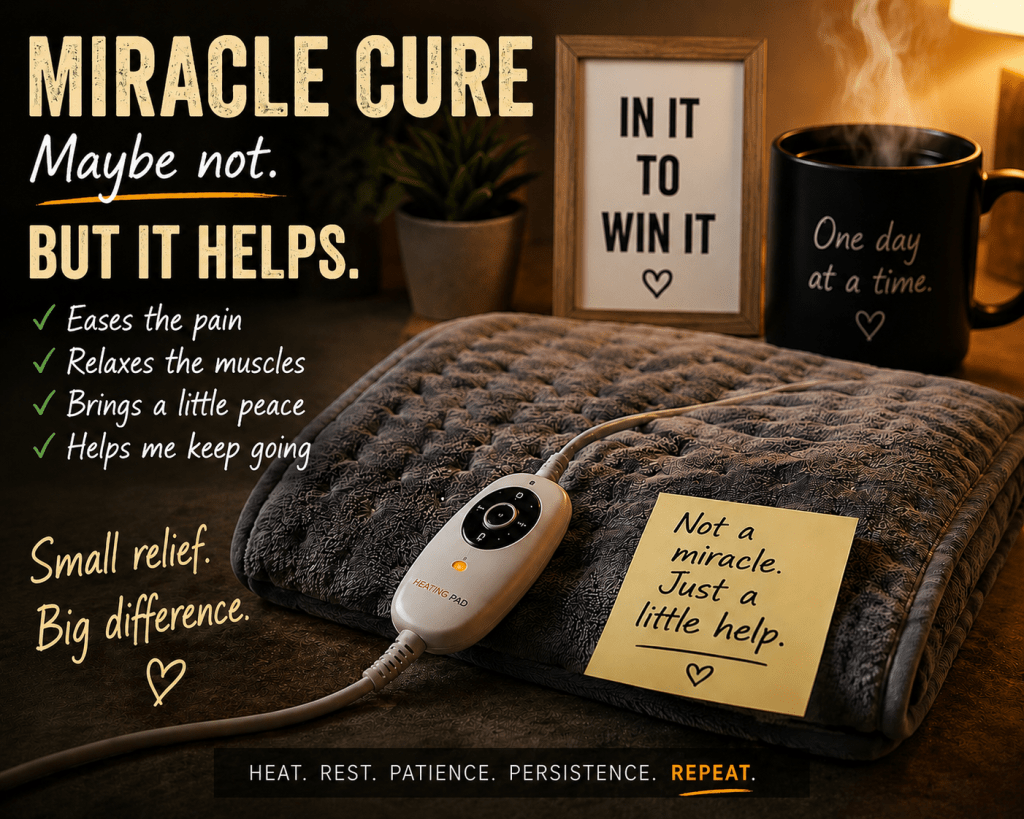
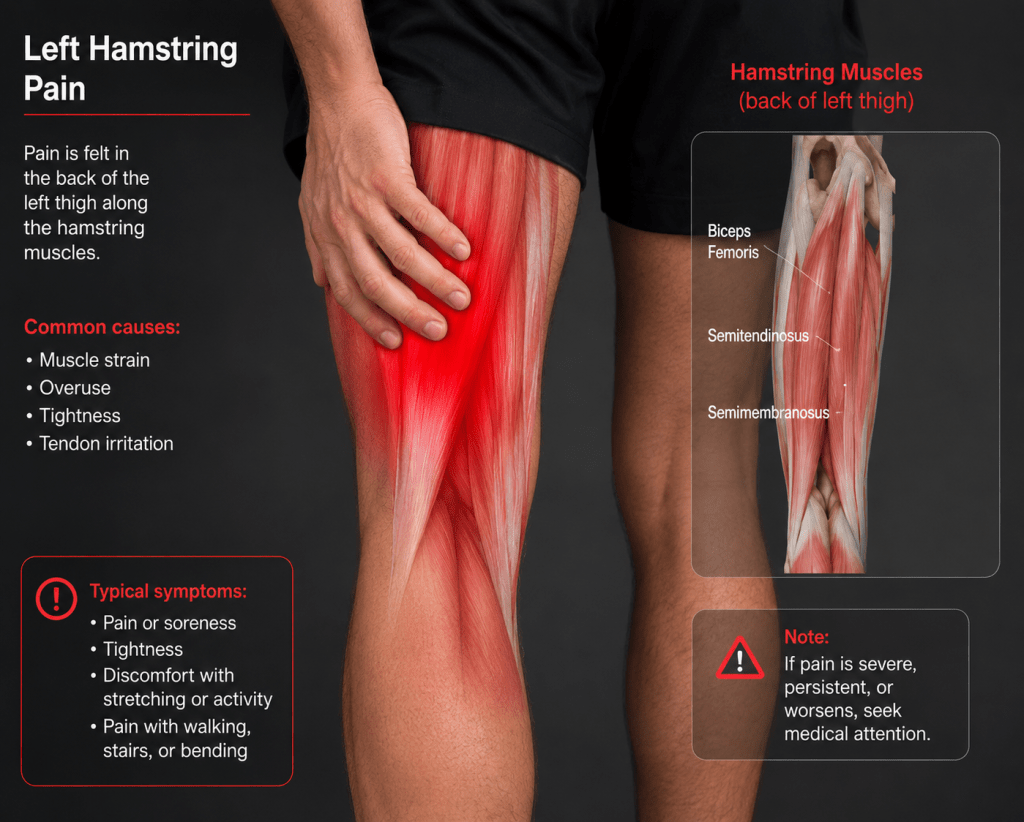
Most of the day centered on my left hamstring. It’s still talking to me, but not nearly as loudly as it has been. I noticed several encouraging signs: I could keep my leg extended longer before the pain showed up, the heating pad on the warm setting brought real relief, and my left butt cheek wasn’t hurting by the afternoon. None of those are headline-grabbing milestones, but together they paint a picture of gradual progress.
The biggest challenge continues to be patience. Not being able to work out the way I want is frustrating, but healing has become today’s workout. I also realized I’ve needed a nap four days in a row. Rather than fighting it, I’m choosing to see that extra rest as part of the recovery process instead of a setback. The nap turned out to be time well spent.
Missy added a little comic relief. She sampled the flower garden by eating grass, then promptly decided to return it a short time later. After a couple of rounds of throwing up, she was back to her normal self as if nothing had happened.
Looking back, today reinforced a simple lesson: progress isn’t always measured in miles or milestones. Sometimes it’s measured in a few extra minutes without pain, a good nap, a warm heating pad, a rainstorm that saves some work, and a dog who reminds you that life has a sense of humor. Those small victories are worth celebrating because they add up over time.
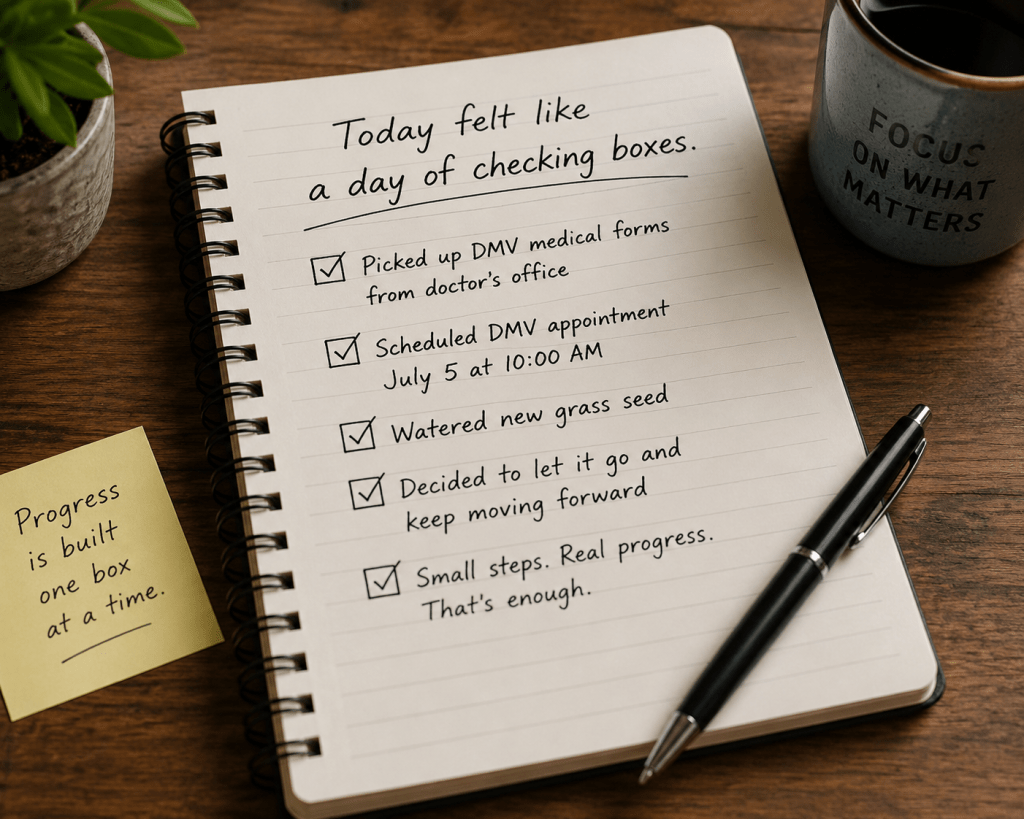
First thing this morning, I picked up my completed DMV medical forms from the doctor’s office. One more hurdle cleared. I also went online and scheduled my DMV appointment for Saturday, July 5, at 10:00 AM. After making multiple trips and waiting more than a week for paperwork, it’s amazing that what should amount to a 15-minute transaction has turned into an eight-day project. That’s bureaucracy for you.
I considered leaving negative feedback when I was asked about my experience, but decided against it. The comments would have been attached to my name, and with Claire working just across the street, it simply wasn’t worth creating unnecessary friction. Sometimes it’s better to finish the race than argue with the course.
This afternoon brought another round of weather roulette. Forecasters have been warning of heavy rain for days, but all we’ve managed to see is a few minutes of light mist. Rather than gamble on promises from the sky, I gave the newly seeded lawn a thorough watering. If a good rain finally arrives tonight, great. If not, at least the grass seed won’t be waiting on a forecast that never showed up.
Some days don’t make headlines. They just move life forward one completed form, one scheduled appointment, and one watered lawn at a time.
Yesterday, I didn’t water the backyard at all. After the soaking it got the day before, I decided to let nature handle things for a while. This morning the soil was still holding plenty of moisture, so I only gave it a light sprinkle, but the weeds are showing up just as enthusiastically as the grass. They’re getting pretty substantial back there, and weed patrol is moving higher on the priority list. A little time spent pulling them now will save a much bigger battle later.
For today, the lawn seems content. The soil is moist, the seed has what it needs, and the garden hose gets a well-earned break. The weeds, unfortunately, have other plans.
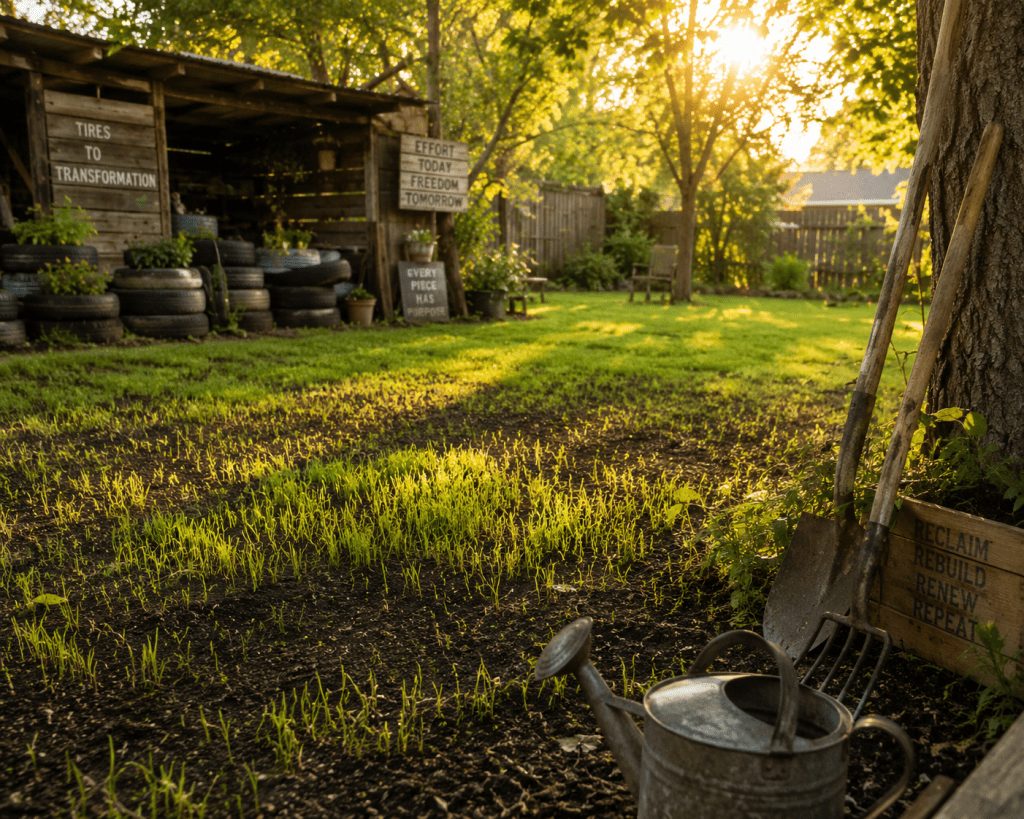
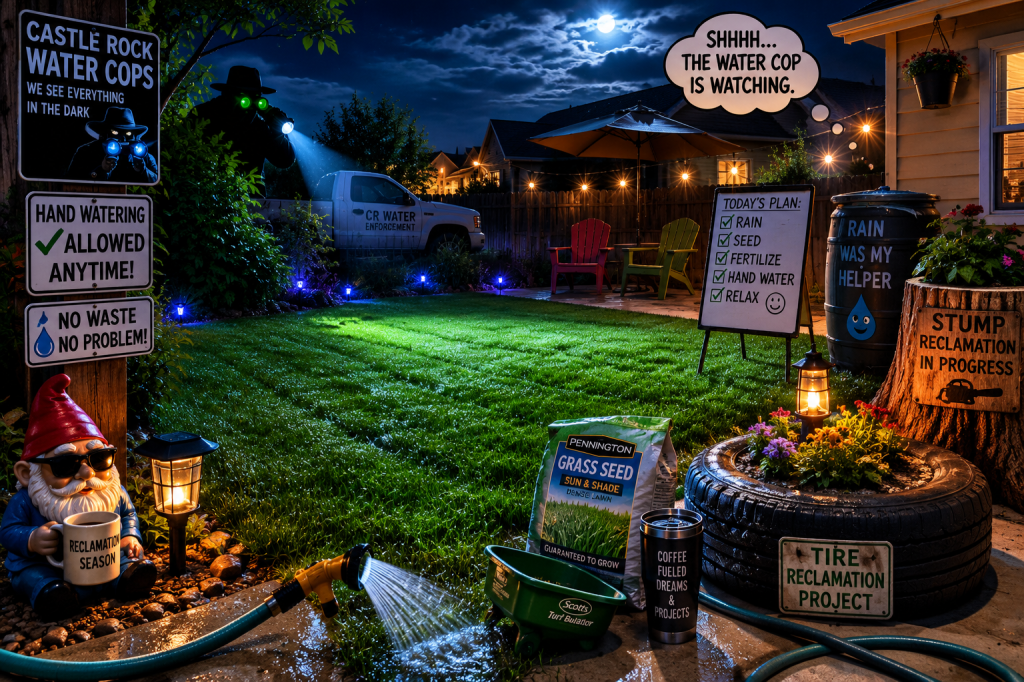
🌱 Backyard Reclamation Project continues. One sprinkle at a time.
😄 Castle Rock’s water enforcement folks have earned a bit of a reputation in local lore, haven’t they?
I can picture the legend now: a silent pickup truck parked three blocks away, a clipboard glowing faintly in the moonlight, waiting for someone to water a petunia at 7:59 p.m.t
In reality, enforcement is usually a lot less dramatic. Water districts tend to focus on obvious violations and water waste—sprinklers running into the street, irrigation during restricted hours, broken systems spraying everywhere, or repeated complaints. They’re generally not conducting covert stakeouts of someone hand-watering a reseeded patch in the backyard.
That said, I understand why you’re cautious. Water is a big deal in Colorado, and Castle Rock takes conservation seriously. The fact that you know the rules about hand watering and are paying attention to them already puts you ahead of many people.
Besides, after today’s rain, if anyone was hiding in the shadows, they were probably getting soaked right along with the grass seed. 🌧️
My guess is that tonight the only thing lurking in your backyard is a bunch of grass seed quietly plotting its grand entrance. Give it a week or two, and you’ll start seeing whether the sod rebuild is paying off. That’s a much more interesting report than anything the mythical Water Cops could write. 🌱👀
This morning my left hamstring is feeling a lot better. That’s a welcome change after dealing with the stiffness and discomfort lately. My plan is to apply some heat and see how it responds before deciding on a workout.
If things continue to feel loose and comfortable after the heat treatment, I may try to get in some exercise today. I’ll take it one step at a time, pay attention to what my body is telling me, and avoid pushing through any pain.
After the last few days, even a small improvement feels like progress. Here’s hoping the heat, movement, and a little determination help keep things headed in the right direction.
The biggest obstacle today isn’t the weather. It isn’t the brown spot in the backyard. It isn’t even the fatigue.
It’s the daily battle with leg pain.
Most mornings begin with the same challenge: aching, discomfort, and limitations that don’t start easing up until around 2:00 p.m. The body feels like it’s staging a protest, making every task more difficult than it should be. Some days that means moving slower. Some days it means changing plans entirely.
Yet the day moves forward anyway.
The clouds continue drifting past the office window. The grass seed can wait. The nap may be necessary. And for now, the goal is simple: make it through the morning and give the body the time it needs to catch up with the day
My legs may file complaints every morning, but all the joints are still functional. The machinery isn’t factory-new anymore, but it’s still operational. Some mornings require extra warm-up time, some require a nap, and some require a little chemical encouragement from the garden. But the wheels are still turning.
Not exactly a brand-new sports car—but the vehicle is still on the road. And after everything your body has been through since 1993, that’s not a small accomplishment
I got the backyard mowed and mostly weeded today. Progress. Real progress. The kind where you stand there afterward looking at the yard thinking: “Okay… this no longer looks abandoned.”
The irrigation is turned on in the front yard and the zones are actually hitting where they’re designed to. That alone feels like a minor engineering victory. Nothing says suburban optimism like watching sprinklers rotate correctly for once instead of watering the sidewalk like they’re protesting drought conditions.
I’ve been pulling weeds out by hand, which turns out to be equal parts landscaping and revenge therapy. Every weed pulled feels personal at this point.
I still have about two big weed piles left, but I’ll get more tomorrow. Today was mainly about getting the yard looking good again and bringing the whole place back under control.
And honestly, it worked.
The grass was 18 inches tall in places not long ago. Now the yard actually looks cared for again instead of “future habitat restoration project.” Between the mowing, the irrigation, and the cleanup, the place is finally starting to breathe again.
Meanwhile the neighborhood soundtrack continues: F-16 flyovers overhead, new backyard chickens next door, sprinklers clicking, and me walking around inspecting grass like I’m preparing for the Masters Tournament. 😄
It is now 4:00 PM. Time for an hour nap before doing a Home Depot run for grass seed. The yard survived. The hamstrings survived. The weeds did not.
Being an adult is realizing it’s absolutely critical to remove your iPhone from your pocket before sitting down to journal.
Nobody warns you about this part of life.
As a kid, adulthood looked like freedom, confidence, and knowing important things. In reality, a shocking percentage of adult decision-making is:
“Wait… where’s my phone?” “Oh no.” slowly stands back up
One bad sit and suddenly you’re gambling your entire communication system against denim dynamics.
And the older you get, the more these tiny routines matter.
Wallet. Keys. Phone. Dignity. Lower back alignment.
All systems check.
Human civilization built rockets, artificial intelligence, and heated car seats, yet every adult still occasionally sits down like a malfunctioning forklift because there’s a rectangle in their pocket.
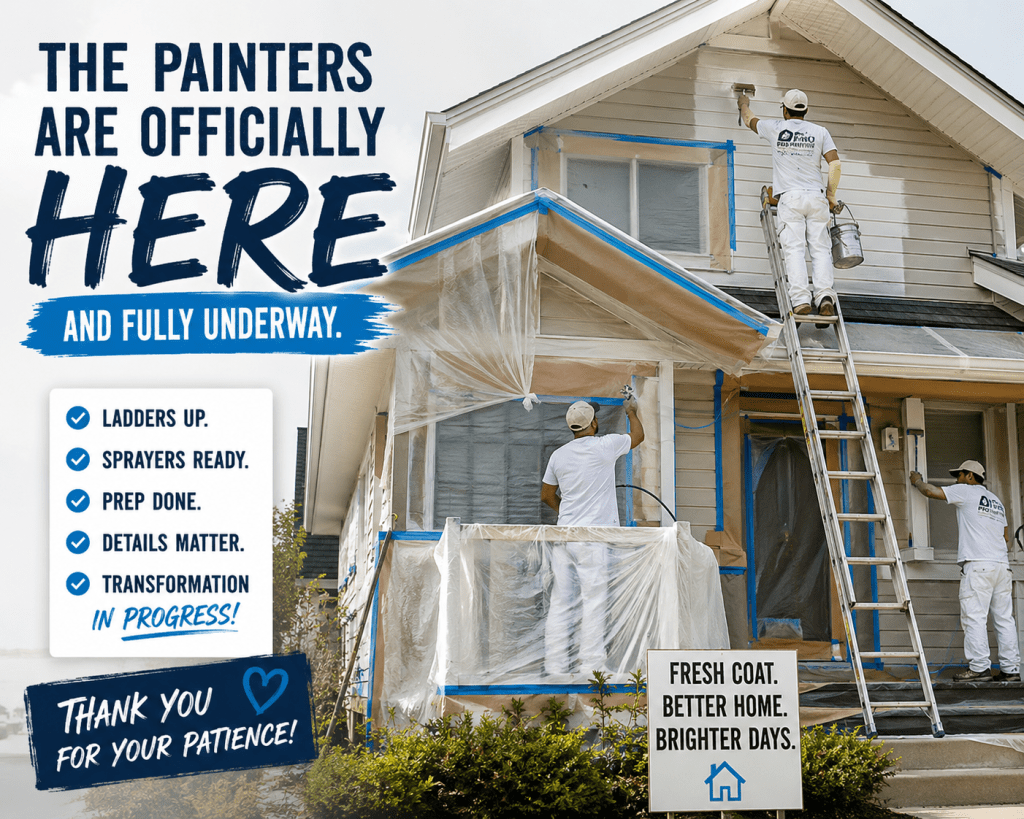
The house painters are officially here and fully underway. Ladders up. Spray equipment runningr. Doors and windows wrapped in plastic like the house entered nasty illness status.
They’re doing excellent work so far.
The main challenge today is keeping Missy inside while the crew moves through the gate carrying ladders and spraying paint. Temporary dog air-traffic control is now in effect.
The good news: the kid made it out and got to work.
Not an easy mission either. Getting in and out of the house right now feels like navigating a construction maze wrapped in plastic sheeting, but he got through it and that’s what counts.
Missy’s handling the crew surprisingly well too. She had one brief choking-and-puke moment after I let her outside, but recovered quickly and has been completely fine since.
Current status:
Paint crew — rolling. House — wrapped. Dog — stable. Stress level — manageable.
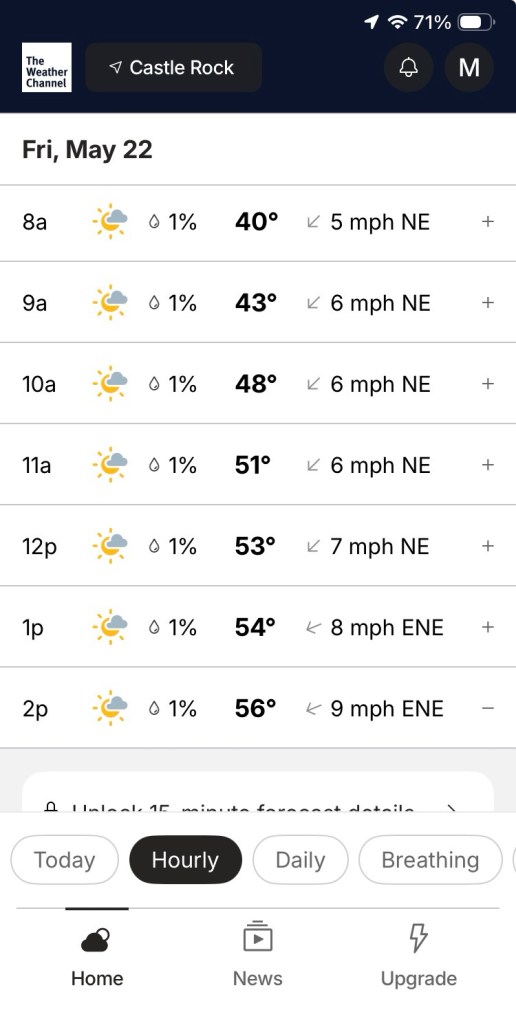
36° is definitely eyebrow-raising for exterior paint day. That’s not “flip-flops and lemonade” painting weather — that’s “the paint better know what it signed up for” weather. 😄
The big thing is the surface temperature, not just the air temp. Most modern exterior latex paints want:
Air and surface temps above about 50°F for standard paint
Some “low-temp” paints can go down to 35°F
But there’s a catch: the temp usually needs to stay above that threshold for several hours after application so the paint can cure properly. Morning shade, damp siding, dew, or overnight freezes can mess with adhesion and curing.
If your painters are legit, they’ll probably:
Wait until late morning/afternoon
Check siding temp with an infrared thermometer
Use a low-temp-rated product if conditions allow
Avoid painting damp surfaces
Bad cold-weather paint jobs can end up:
Streaky
Soft/tacky
Peeling early
Looking uneven later
Honestly, this is one of those moments where a good painting crew earns their money. A bad crew sees 36° and says “send it.” A good crew starts checking forecasts like meteorologists guarding the launch window for Apollo 11. 🚀
If you want, I can also help you figure out:
whether today’s forecast in Highlands Ranch is actually safe for painting,
what temperature Sherwin-Williams/Behr products require,
or what questions to ask the crew before they start.
40° at 8 AM and only 48° by 10 AM means the siding itself is probably still colder than the air, especially on shaded sides of the house. By 11–1, though, you’re finally getting into the “okay, now we can talk” range for most exterior acrylic paints.
Honestly, this is probably the best-case scenario:
dry air,
almost no chance of rain,
light wind,
gradual warmup into the 50s.
That’s workable if they start later in the day.
The Front Range really does this every spring: 7 AM: “survival conditions” 1 PM: “maybe patio weather” 7 PM: “find the hoodie again”
My coffee may end up curing faster than the paint this morning.
Version 2
The morning finally started moving.
Claire made it home from King Soopers successful and victorious from the Friday double fuel points campaign, while the weather outside continued its slow crawl from “frost advisory energy” toward actual spring.
Meanwhile, Dakota was already up before 7 AM for work after not getting home until 1:50 in the morning.
That’s the kind of schedule that turns a human being into pure caffeine and momentum.
The house this morning feels like three separate timelines happening at once:
contractors operating on weather delay,
grocery logistics complete,
exhausted work schedules still rolling forward anyway.
And through all of it: coffee remains undefeated.
The forecast now makes more sense too. The painters probably looked at those early temperatures and decided the siding deserved a little more time before becoming modern art.
Classic Colorado May: winter in the morning, reasonable human existence by lunch.
The day is still assembling itself piece by piece, but at least everybody’s accounted for now: Claire home, Dakota upright, coffee hot, and the paint saga still pending
Laundry day turned into a full household reset today.
Started the morning the usual way — cleaning up the kitchen before the day really got moving. There’s something satisfying about getting the counters cleared and the sink empty before the weather and chaos start making their own plans.
After throwing in the laundry, I shifted into appliance-detail mode and cleaned up the exterior of both the washer and dryer too. One of those small maintenance jobs nobody talks about, but it changes the whole feel of the room afterward. Quiet progress still counts.
The Amazon delivery showed up around 9 this morning with a new billfold, and car keys are officially back on the tracking grid. Tiny batteries. Massive peace of mind. Modern life is basically just keeping tiny circles of lithium alive so we can find our stuff.
Outside, Colorado kept doing what Colorado does best — weather improvisation. Heavy rain moved through most of the morning before the clouds partially broke and the sun briefly pushed through. Not fully sunny, not fully storming. Just enough light to remind everyone the sky still exists up there somewhere. More rain is expected this afternoon.
And somewhere in the middle of all this, the nap signal started coming in loud and clear.
Honestly, rainy laundry days are basically nature’s prescription for an afternoon reset. The kitchen got handled. Laundry is moving. The house feels tighter. The tracking system is back online. The mission for today doesn’t need fireworks.
Some days are for conquering mountains. Some days are for maintenance.
Today feels like both survival and progress at the same time.
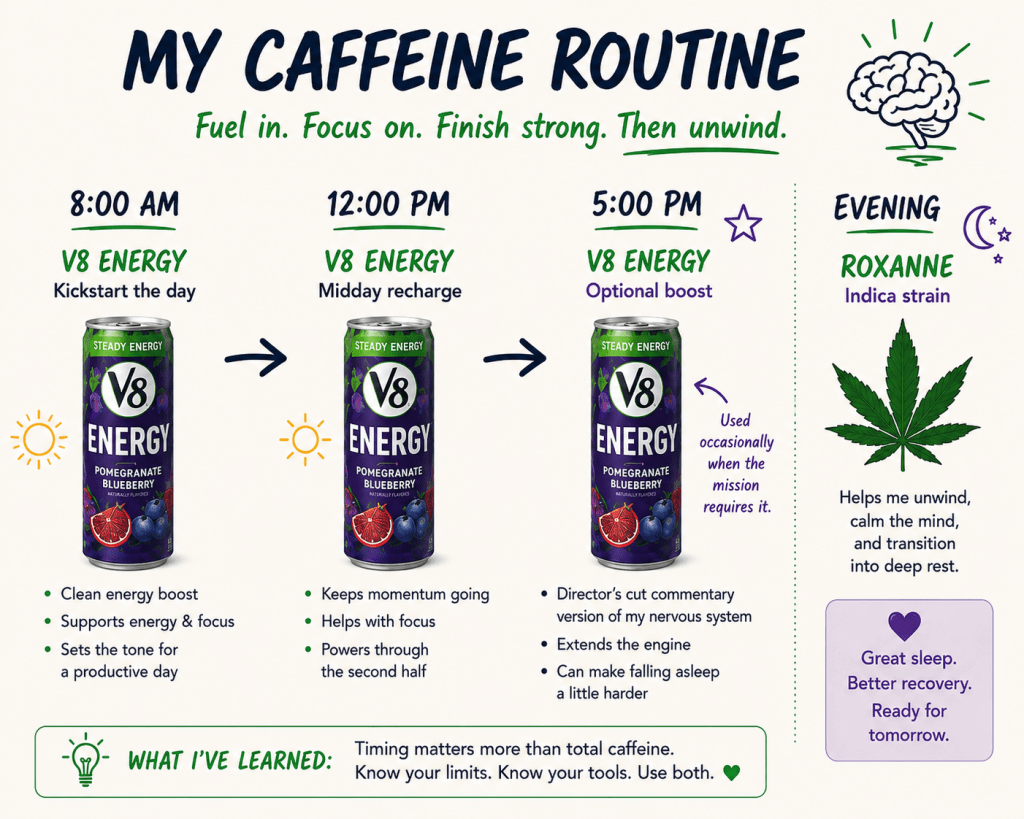
No major problems. No wild jitters. I usually sleep surprisingly well considering the amount of caffeine involved. Some people hear “energy drinks” and picture a raccoon driving a shopping cart through a fireworks factory. Meanwhile I’m over here sleeping like a retired house cat.
But two nights ago, science happened.
For the first time, I cracked open a V8 Energy at 5 PM.
But later that night, my brain was clearly still accepting applications for additional consciousness.
I eventually realized something kind of funny: the late can didn’t necessarily make me feel crazy wired — it just quietly kept the engine running longer than normal.
That’s the sneaky thing about these drinks.
Because they come wrapped in fruit, vegetables, and “healthy energy” marketing, your brain expects a polite little afternoon boost. But caffeine is caffeine, and the body keeps receipts.
Normally:
8 AM works
Noon works
5 PM apparently activates the “director’s cut commentary” version of my nervous system
To be fair, I still slept. It just took longer to fall asleep than usual, which almost never happens for me.
Thankfully, my evening Indica strain, Roxanne, stepped in like a veteran night-shift supervisor.
That helped smooth things out considerably.
Not in a dramatic “lights out instantly” kind of way — more like: “Alright everybody, wrap it up. The brain party is over.”
Honestly, the whole experience taught me something useful: timing matters more than total caffeine sometimes.
Especially when your nervous system has already survived a few plot twists over the years.
So there I was, sitting in my chair during a light Colorado rainstorm, watching vintage rock ’n’ roll videos on YouTube with Eric Clapton pouring through my Apple earbuds like it was 1977 again.
Then it happened.
A quick jolt.
Not a dramatic Hollywood earthquake. No dishes flying. No ceiling collapse. Just enough of a sudden shake to make me stop and think:
“Hold up… was that the earth moving, or did Slowhand just hit a note so hard it rattled Douglas County?”
The chair shook briefly and then stopped.
Most importantly: the dog did not freak out.
And dogs are basically furry seismic detection systems with opinions.
No barking. No panic. No sprinting through the house like the apocalypse had arrived.
Which means this probably lands somewhere between:
tiny ground vibration
distant thunder rumble
heavy truck
house settling
or Colorado reminding everyone it occasionally wiggles a little
Still, when you combine: light rain + noise-isolating earbuds + vintage rock + complete silence otherwise…
your brain immediately starts narrating life like a Discovery Channel disaster documentary.
For a second there, I was halfway convinced Eric Clapton himself had bent spacetime with a guitar solo.
Thankfully, the house is standing. The dog remains emotionally unavailable. And the rain continues.
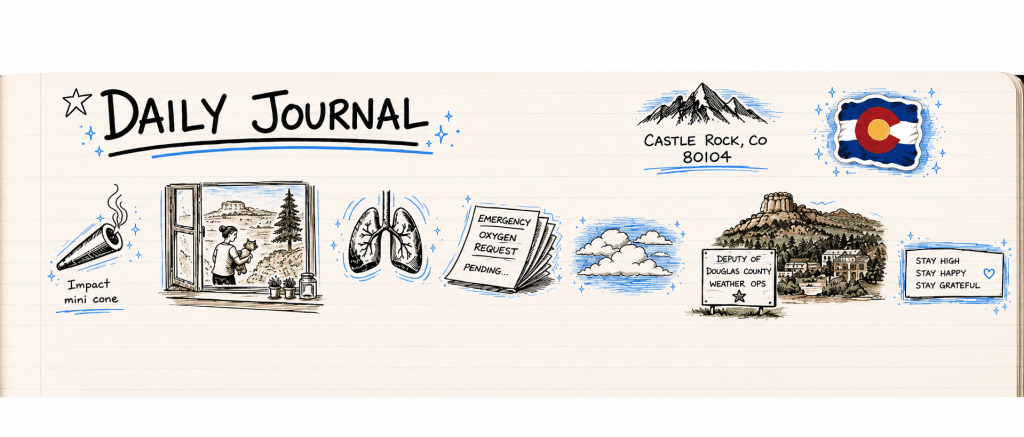
Loaded an mini cone and quietly relocated to the master bedroom bathroom for what was supposed to be a peaceful launch sequence. Took an absolutely disrespectful inhale, turned toward the window to admire the Castle Rock morning… and locked eyes with the neighbor outside scooping up her cat like she had just witnessed a forest fire begin indoors.
She immediately retreated back inside.
Probably for the best.
At that exact moment my lungs were filing emergency paperwork and requesting additional staffing.
Outside, the Castle Rock sky started shifting moods again — little clouds drifting through the blue like the Colorado weather was soft-launching tonight’s nonsense. You can feel it out here before it happens. The wind changes tone, the light gets weird, and suddenly everybody’s patio furniture is in a survival situation.
The cat probably went back inside like: “Margaret… the bathroom wizard is active again.”
Meanwhile I’m standing there absolutely orbiting, watching clouds drift over Castle Rock like I’m the unofficial deputy of Douglas County weather operations.
Because in Missy’s furry little Chow Chow brain, you are apparently the designated “safe blast zone.” 😄
Dogs do weirdly social things with vulnerable body moments. A lot of them:
• fart near people they trust • sleep with their back or butt toward their “pack” • seek closeness when uncomfortable
So there’s a decent chance she’s thinking:
“Dad protects. Dad accepts. Dad will survive this chemical event.”
Meanwhile you’re down there in the trench getting hit with what smells like canned chili and old tennis balls.
There’s also a practical dog reason. Under your legs probably feels:
• sheltered • warm • den-like • close to your scent
And if she’s gassy, she may actually be a little uncomfortable and subconsciously wants comfort. Unfortunately, her comfort system has a side effect worthy of an EPA field report.
Classic dog logic: “I love you deeply. Please inhale this.” 🐕💨
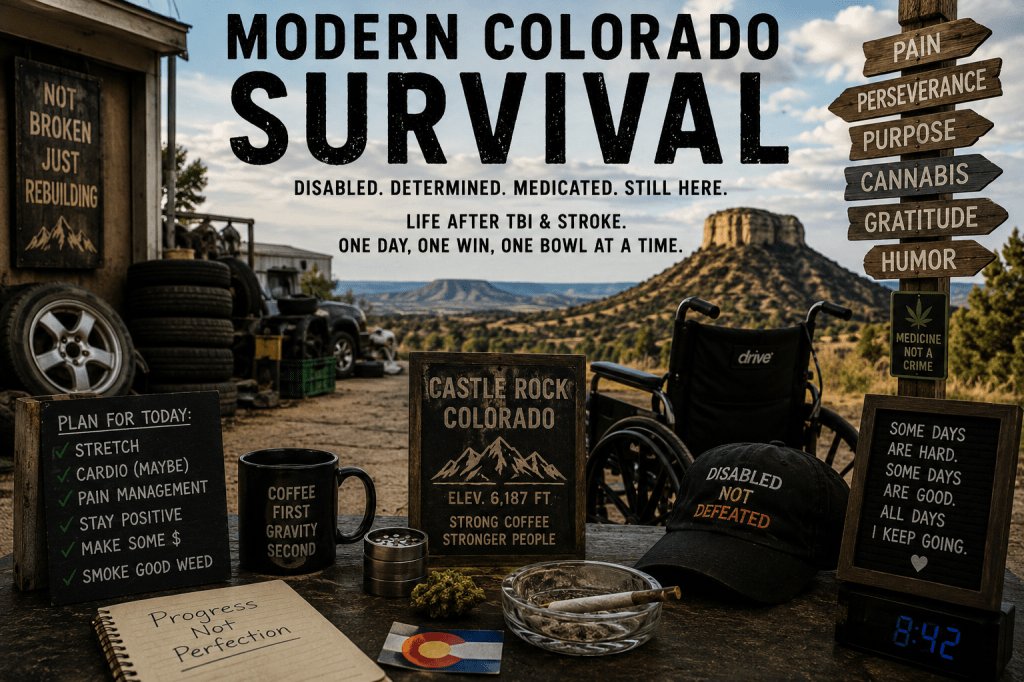
Today’s Pain repertoire includes knee pain, cardio goals unbelievably, disability, and whether MythBusters still rules.
Welcome to modern Colorado survival.
Living disabled after a TBI and stroke means some days feel like a strategy game nobody prepared you for. Buttons become engineering projects. Zippers become boss battles. Knees suddenly hold press conferences about poor working conditions.
But the mission continues.
This morning started with negotiations between my left knee, my cardio goals, and the part of my brain that still thinks I can move like it’s 1992. The knee immediately rejected the proposal.
Today’s flower delivered a solid mental reset while helping turn down some of the daily background static that comes with disability, pain, and recovery. Not magic. Not a cure. Just enough breathing room to keep moving forward.
Meanwhile, MythBusters was on in the background launching objects into oblivion like federally funded chaos goblins, and honestly… it still rules.
Modern Colorado Survival: Hamstrings, Whole Foods, and MythBusters
Today’s pain repertoire includes knee pain, cardio goals somehow still existing, disability, and whether MythBusters still rules.
Welcome to modern Colorado survival.
Living disabled after a TBI and stroke means some days feel like a strategy game nobody prepared you for. Buttons become engineering projects. Zippers become boss battles. Knees suddenly hold press conferences about poor working conditions.
But the mission continues.
This morning started with negotiations between my left knee, my left hamstring, and the part of my brain that still thinks I can move like it’s 1992. The body immediately rejected the proposal.
Still, I got out and handled business.
I took my pressure washer back to Whole Foods for an Amazon return. The actual return process was effortless. Scan the code, hand over the item, mission complete.
The hard part was the walking while carrying a big box.
From the parking lot to the entrance, then across the store to the Prime desk, my knee and hamstring made sure I understood every single step. But I got it done.
I started the day with a little sativa before leaving the house. One pull of reefer got me through transportation, walking, navigating the store, and dealing with public life without mentally ejecting myself into orbit.
After getting home, the indica division was activated for recovery operations.
Today’s flower delivered enough calm to turn down some of the background static that comes with disability, pain, recovery, and the exhaustion that can come from simply being out in the world.
Not magic. Not a cure. Just enough breathing room to keep moving forward.
Meanwhile, MythBusters was on in the background launching random objects into oblivion like federally funded chaos goblins, and honestly… it still rules.
There’s something comforting about watching people fail spectacularly, learn something useful, and keep going anyway.
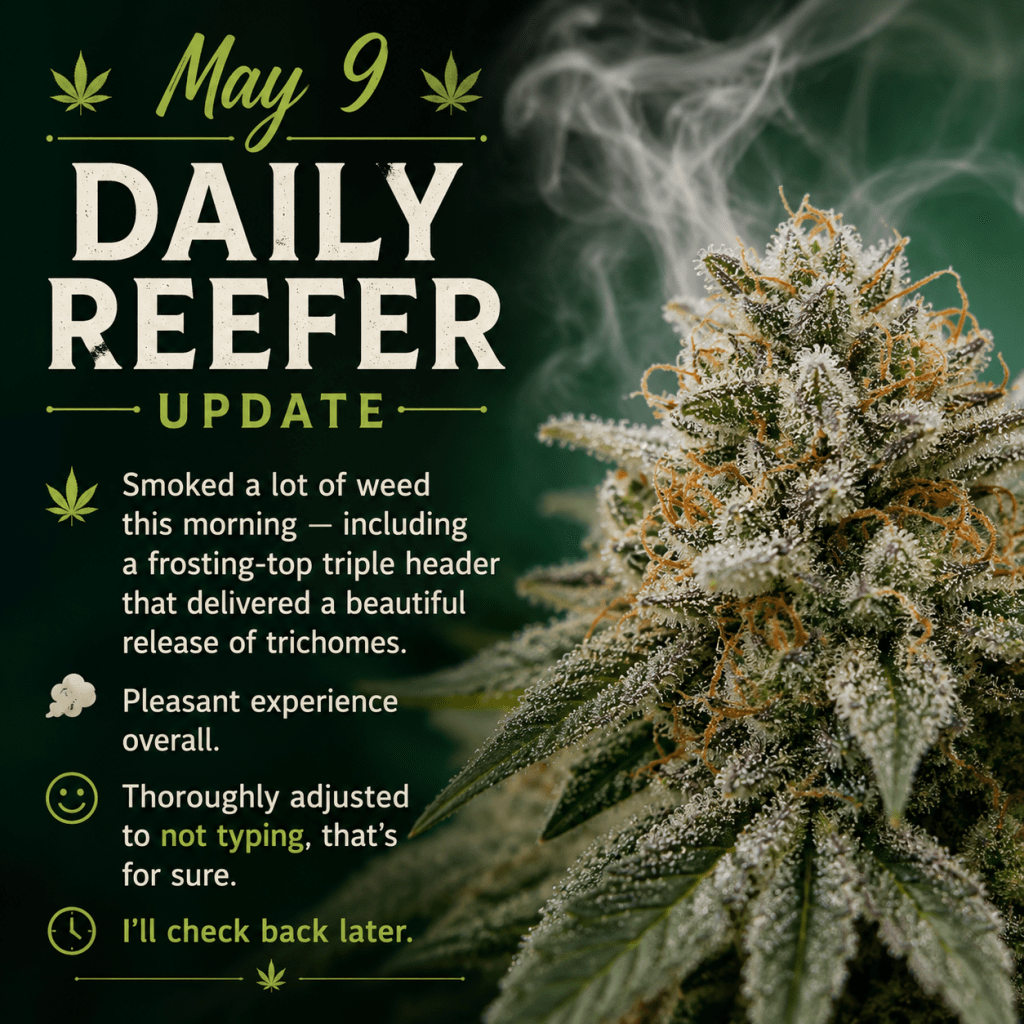
Smoked a lot of weed this morning — including a frosting-top triple header that delivered a pleasant release of trichomes. Outstanding experience overall. Thoroughly adjusted to not typing, that’s for sure.
I want to enjoy watching the Colorado Avalanche dominate the ice. I really do.
But there’s just one problem… Sometimes I can’t track the puck to save my life.
And yeah, I’ve asked myself the question: Is it the game—or is it me?
After a traumatic brain injury and a stroke, things don’t always process the same. Hockey is fast. Like blink-and-it’s-gone fast. That tiny black puck? It might as well be playing hide-and-seek on expert mode.
But here’s the deal—I’m not tapping out.
Instead, I’ve had to change how I watch the game.
I stopped trying to follow the puck like a sniper and started watching the players instead. The movement. The flow. Where the play is building before it actually happens. Turns out, hockey makes a lot more sense when you zoom out mentally.
And honestly? It’s made the game better.
I still lose the puck sometimes. Happens. But I catch the big moments—the passes, the setups, and yeah… when the Avs bury it in the net.
That’s what matters.
There’s something bigger here too. Sometimes your brain throws a wrench into how you used to do things. Doesn’t mean you’re done—it just means you adapt.
So if the puck disappears on you now and then, welcome to the club. We’re still watching. Still cheering. Still in it.
And when the Avalanche score? You don’t need perfect vision to feel that.











 It’s My Life