Friday the 13th. Some people hide under a blanket for it. Me? I just put my shoes on and get on with the day.
Morning started like most: wake up, assess the body inventory. Knees talking? ✔️
Right side a little slow to clock in? ✔️
But the important part is the system boots up and we roll.
Coffee on board. Brain warming up. Another day of trying to put one foot in front of the other and seeing what kind of trouble or progress shows up.
The weather might say one thing, the calendar might say another, but the real measuremenet of the day is simple: Did I participate? Did I think? Did I show up?
Sometimes the victories are loud. Sometimes they’re quiet. Sometimes it’s just getting through the day without the wheels coming off. That still counts.
Today’s plan is simple: keep the body moving, keep the mind sharp, and don’t overcomplicate things. Life already does enough of that for free. No charge.
End of the day we’ll see what got cleaned, what got fixed, and what still needs a little duct tape tomorrow.
Friday the 13th or not… the day’s mine to run with.
I was laying on the office couch doing the iPad thing, not listening to anything in particular. Just quiet. The kind of quiet you notice because it isn’t trying to be anything.
Then I heard it.
A soft buzzing drifting past the window. Not urgent. Not fast. Just steady.
Sounded like a drone cruising through the neighborhood like it owned the place. It moved off to the right and the sound disappeared as quickly as it arrived.
For a second I wondered if it was a drone… or extraterrestrials doing a casual flyby.
Brain Injury, Stroke, Traffic, and Why I Stay safe
I’ve lived with a TBI near about 27 years and a ischemic stroke within the last two years. Another challenge.
That changes how the world feels.
A lot of people assume that if someone doesn’t go outside much, they’re just avoiding things. Lazy. Antisocial. Overthinking.
Traffic Feels Different After a stroke
One thing people don’t talk about much is how a damaged nervous system reacts to noise and unpredictability.
Traffic is a perfect storm of both.
Engines revving.
Trucks accelerating hard.
Sudden bursts of noise and motion.
For most people it’s background sound. They filter it out.
For me, my brain flags every one of those signals as important.
Not necessarily dangerous — just loud, fast, and unpredictable.
That kind of input piles up quickly.
Living Somewhere You Don’t Like
I live in Castle Rock.
To be honest, I don’t like it here.
It’s loud. There are a lot of big trucks. A lot of aggressive driving. The kind of place where engines seem to announce themselves constantly.
If moving were easy, I probably would.
But moving costs money, and sometimes reality is simply that you stay where you are because that’s what you can afford.
So the situation is what it is.
Staying Inside Isn’t Giving Up
Because of all that, I spend a lot of time inside.
And I’m actually okay with that.
Inside, things are predictable.
The environment is controlled. The noise level is manageable. My nervous system can settle down instead of reacting to whatever just roared past on the road.
That doesn’t mean I stop living.
I exercise at home.
I work on physical therapy at home.
I write at home.
I organize my thoughts at home.
It’s not retreating from life. It’s building a version of life that works with the brain I have now.
Small Victories Still Count
Recovery and adaptation aren’t dramatic.
They’re small decisions.
Getting on the exercise machine.
Doing the stretches my physical therapist just gave me.
Taking care of my body even on days when it feels like work.
That’s the real version of resilience.
Not pretending everything is normal.
But figuring out how to move forward inside the reality you’re living in.
Memory is unreliable. A blog becomes a time machine. Months or years later you can look back and see exactly where you were mentally, physically, or spiritually. A lot of people don’t realize how powerful that is until later.
There’s something deeply satisfying about a good pair of slip-on shoes. No laces. No fuss. Just step in and go.
I’ve been wearing a pair of Skechers slip-ons lately, and they might be the most comfortable shoes I’ve ever owned. They do exactly what they’re supposed to do: support your feet, stay out of the way, and let you move through the day without thinking about them.
That’s good design.
But here’s the funny part.
As good as they feel when you put them on in the morning, the best moment comes at the end of the day.
You sit down at your office chair.
You lean back a little.
And then—kick… kick.
Shoes off.
No ceremony. No bending down. No untying knots that somehow tightened themselves during the day. Just a quick flick of the feet and freedom.
It’s the small victories.
Those shoes sit right next to my office chair. In the morning, they’re waiting there. Slip them on and the day starts. At night, they come off just as easily and the day is officially done.
Simple system. Works every time.
Sometimes people overthink comfort. They chase complicated solutions, expensive gear, or the latest trend.
Meanwhile, the truth is a lot simpler.
A good chair.
A good pair of shoes.
And the simple joy of kicking them off when the day is done.
After years of physical therapy, recovery, and learning how my body works after a brain injury and a stroke, I’ve noticed something simple.
When my body feels good, I just know it.
There’s no complicated checklist. No spreadsheet. No formal evaluation. And importantly—I wasn’t in therapy the whole time; my body tells me when it’s pained on its own. The signal is internal. A quiet sense that today is a little smoother, a little steadier. On those days, I go with it.
That feeling has become one of the most useful tools I have.
Waking up at 3–5 AM
If you felt wide awake — not anxious, not in pain — that’s actually useful data. That suggests it wasn’t distress-driven. It might just be:
I didn’t jump into cannabis the moment Colorado legalized it. I gave it two years.
Two years to let the noise die down. Two years for the regulations to harden into something real. Two years to see whether this was a flash of rebellion or the beginning of an actual industry.
When I finally applied for a job, I got hired. That’s when the real education began.
⸻
Paid in Cash, Living in Contradiction
Getting paid in cash every week was almost surreal. Too cool, honestly. Stacks of $100 bills handed over like it was the most normal thing in the world.
And still illegal federally.
It wasn’t about the money itself — it was about what it represented. We were legal in Colorado. Fully operational. Taxed. Regulated.
That contradiction hung in the air every day.
Everything felt alive. Improvised. Slightly unfinished. The industry was young and trying to grow up fast. Policies shifted. Compliance tightened. The wild edges got trimmed. But in those early years, you could still feel that you were standing in a moment that wouldn’t last.
⸻
Paperwork and Patience
Working in a space that was legal at the state level and illegal federally meant extra layers of paperwork and scrutiny. Income had to be reported properly. Every dollar had to line up.
It wasn’t dramatic most days — just persistent. A quiet reminder that the larger legal picture hadn’t caught up yet.
There was a stretch when things felt especially tight. Payments were delayed. Systems moved slowly. I went nine months without a check I had been counting on.
Nine months.
No safety net. No quick answers. Just waiting, working, and staying steady.
⸻
Choosing Stability
What grounded me was action.
I picked up a part-time job in the powder coating industry. I reported my income the way I was supposed to. No shortcuts. No gray interpretations. Just straight compliance and patience.
Eventually, things settled.
No grand resolution. Just stability returning in its own time.
⸻
Living in the Seam
Looking back, that period wasn’t just about cannabis or cash. It was about navigating adulthood inside a system that hadn’t fully aligned with itself. It was about standing upright when the rules didn’t quite agree. It was about doing things clean, even when the framework felt inconsistent.
Colorado was willing to move forward.
Federal law was slower to change.
And I lived in the space between the two.
That time was thrilling in moments, exhausting most days, and undeniably real. It taught me patience. It taught me discipline. It taught me that sometimes the strongest move isn’t rebellion — it’s steadiness.
There’s a difference between avoiding effort and adjusting effort.
For a long time, I couldn’t tell the difference.
If I took a day off, I felt guilty.
If I took a week off, I felt like I was sliding backward.
After a brain injury and a stroke, effort isn’t just about willpower. My nervous system doesn’t always fire evenly. That shows up in my gait. In the limp. In recovery time.
Explaining it mechanically keeps it neurological instead of moral.
I’m not lazy.
I’m recalibrating.
2. The Shower Debate
Two days without a shower.
Not because hygiene doesn’t matter — but because the effort had a cost.
When you’re managing pain, recovery, and energy regulation, even a shower becomes a negotiation.
“If I’m not working out, why shower?”
Then I stepped in.
Hot water. Steam. Stillness.
When I got out, I didn’t feel perfect.
I felt good.
Sometimes maintenance isn’t about productivity.
It’s about momentum.
3. Weed Day
There’s ritual in it.
Cleaning the supply. Replacing it. Air moving through the house. Fan on. Draft from bathroom to office.
Outside, Castle Rock hums with loud trucks and hard acceleration. It feels aggressive sometimes.
Three days short of my quarterly weed run… and bone dry. That’s called poor inventory management, folks.
So this morning I did a thing.
Loaded up the 2015 Mini Cooper Countryman and rolled out solo to make the pilgrimage to basically Hampton & Monaco — back through the fortress door at Green Cross of Cherry Creek.
Bud boss at the door. Weed certs presented. Clearance granted. Crossed to the other side to conduct official business.
These guys used to handle my medical plants, so there’s history there. Trust matters. Two visits ago they introduced me to this grow — Kushmas — born and bred down in Pueblo West, Arkansas River Valley water. A little terroir change from the Platte River drainage up here in Denver. Call it a flavor vacation.
Walked out with:
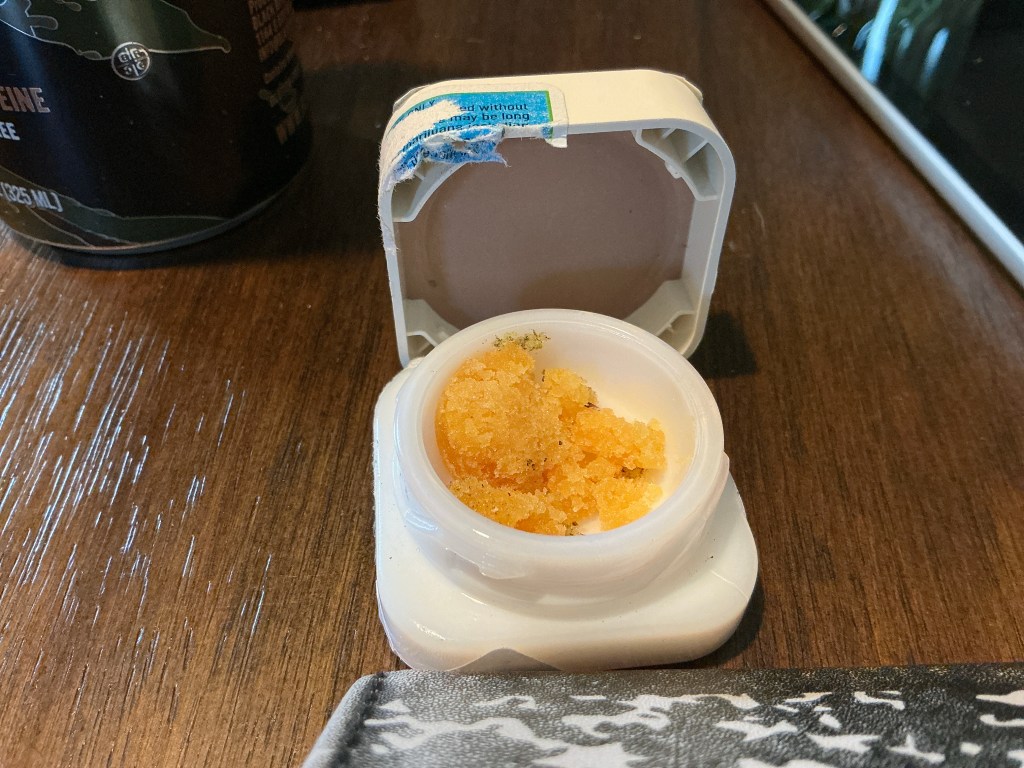
$15 eighth of Kushmas flower 2 grams of packaged oil at $4 a gram
That’s not boutique pricing. That’s “we stand behind this” pricing.
On the way out, the guy ahead of me held the door. Then held the next one. There’s a step down at the second door — he even offered his arm for support. I thanked him, but I was good.
And that’s the part that sticks.
Yeah, I bought weed.
Yeah, I was out and needed to restock.
But I drove myself. Handled my business. Walked it out steady.
First and foremost, it gives me something solid to show for my day.
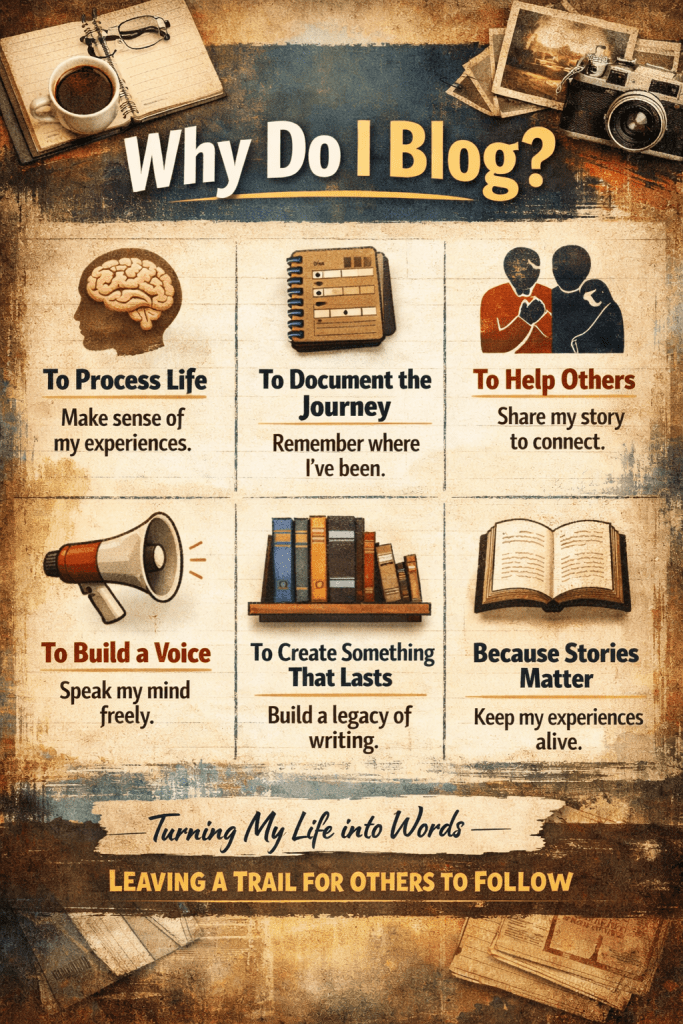
Not every day comes with visible progress. Recovery is slow. Thoughts are messy. Time can slip by without anything concrete to point to. But when I write, there it is — a page, a post, a record. Proof that I showed up.
Writing turns an invisible day into something tangible.
There is only one boss: my spell check.
No committee. No performance review. No applause meter. Just me, the keyboard, and the quiet discipline of putting words together in a way that makes sense. Spell check might argue with me, but it’s a fair boss. It doesn’t care about status. It doesn’t care about noise. It just wants clarity.
I like that.
Writing slows my thinking down enough for me to see it. It forces honesty. If a sentence doesn’t work, I fix it. If a thought doesn’t hold up, I reshape it. That process feels constructive. It feels like progress.
On days when everything feels scattered, writing gathers things up.
On days when the world is loud, writing gives me control over the volume.
And at the end of it, I have something real — something I made.
That’s why I like to write.
Version two
Day One Journal Entry
One Journaling App
I need to convince myself to stick with just one journaling app, and I’m leaning toward Day One.
There’s something about having everything in one place that feels calmer — less scattered, less searching. One timeline. One archive. One habit.
When I bounce between apps, it works, but it also feels unfinished. Like I’m halfway committed in two directions. Choosing one feels intentional.
Day One is built for journaling. It feels like a home for thoughts, not just a storage bin. That matters.
Recovery after my stroke isn’t dramatic or linear. It’s slow, repetitive, and easy to lose track of. Writing gives that process structure. It helps me notice patterns, track progress, and make sense of days when my thinking feels foggy or uneven. When my brain gets overwhelmed, the page doesn’t. It waits.
Writing things down is part of how I rebuild clarity — one entry at a time.
In other news, I still have some sativa left over from a half‑gram joint from my stepbrother John. It’s early. I could change my mind. But honestly, I think I’m good for the day.
Living with a traumatic brain injury has made clarity not just helpful, but essential.
The Olympics are over, and I didn’t realize how much space they were taking up until they were gone.
I watched them as they happened — live or as they were broadcast — and by the end, the constant coverage felt less like sport and more like saturation. Endless stories, polished narratives, and a spotlight on access and privilege that’s hard to ignore once you see it. It was impressive, sure, but also exhausting.
Maybe that’s because I’m already dealing with enough noise.
Between my ongoing recovery, heightened sensitivity, and literal construction crews outside my house running machines for days on end, my nervous system has been running hot. Add nonstop Olympic coverage to that, and even something celebratory becomes one more thing my brain has to process.
When you’re healing, stimulation hits home differently.
Now that it’s over, there’s relief.
The evenings feel quieter. The pressure to keep up is gone. There’s no more “what did I miss?” or countdown to the next event. Just space.
And that space is letting me return to something that actually steadies me: writing.
Blogging isn’t about reacting in real time. It isn’t about spectacle. It’s about slowing down enough to notice what’s true. It’s about making sense of experiences that don’t fit neatly into highlight reels or broadcast packages.
At my desk, with a iPad open and a cup of coffee cooling beside it, there’s no crowd noise. No commentary. No medal ceremony. Just thought, reflection, and the quiet discipline of putting words on a page.
Sometimes progress isn’t about adding more.
Sometimes it’s about subtracting the noise.
The games are over. The machines outside will eventually move on. And here I am — back at the desk, back to writing, back to hearing myself think.
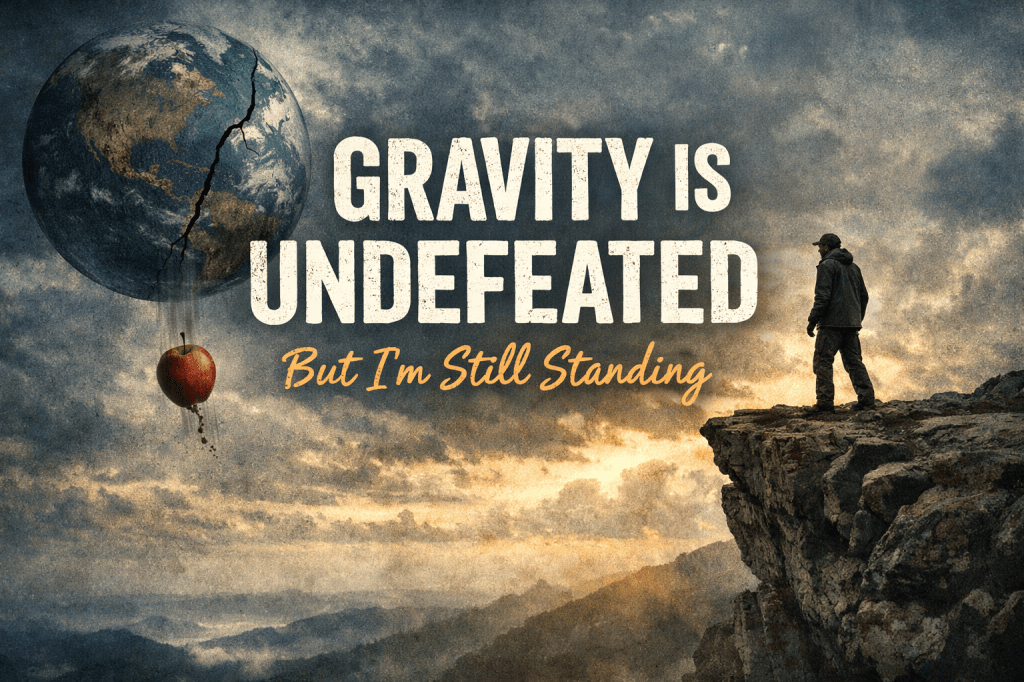
If you’ve got beef with that statement, take it up with Isaac Newton. He turned a falling apple into a universal law, and now the rest of us are stuck living under it.
Gravity doesn’t negotiate.
It doesn’t care how motivated you are.
It doesn’t care how hard you trained.
It just waits.
Patiently. Like a bouncer with a physics degree.
It’s Not “Just a Fall”
People love to say, “He fell.”
No. Gravity collected.
There’s something brutally honest about realizing your biggest opponent isn’t fear, doubt, or effort. It’s a constant downward pull that’s been here since Earth clocked in.
Every wobble.
Every misstep.
Every time your knee clears its throat and says, “Remember me?”
That’s gravity sending a reminder notice.
It doesn’t need ice.
It doesn’t need drama.
It doesn’t need a bad decision.
It just needs opportunity.
The Hidden Tax
Gravity taxes momentum.
It taxes confidence.
It taxes recovery.
You can feel unstoppable one second — balanced, centered, locked in — and the next second you’re having a very personal meeting with the ground.
And once you’ve truly been introduced to the ground, you gain a deep respect for:
Stairs Slopes Sidewalks Grocery store tile Anything slightly uneven
Gravity is consistent. Relentless. Professional.
The Twist Nobody Talks About
Here’s the part they don’t put in the physics textbooks:
If gravity is always pulling down, then every time you stand up, you’re resisting the universe.
Standing isn’t neutral.
Walking isn’t casual.
Balance isn’t automatic.
It’s defiance.
Every step is a quiet middle finger to physics.
Final Word
Gravity sucks. It always has.
But here’s what it can’t calculate:
Stubbornness.
Newton wrote the equation.
He didn’t solve for grit.
And sometimes, grit beats gravity — at least for today.
We went to Woodland Park on Sunday morning, just outside Colorado Springs, and I didn’t get out of the car the entire time. That wasn’t a failure—it was the right call. Being there was enough.
It was a totally awesome experience simply sitting in a real mountain town—no glitz, no spectacle, none of the polished urgency you get in resort-driven places. No pressure to participate. No expectation to keep up. Just mountains, quiet, and space that didn’t demand anything from me.
After my stroke, public spaces take more out of me than they used to. Crowds, movement, unpredictability—my nervous system notices all of it. I don’t hate going out; I hate being overwhelmed. Knowing the difference matters.
The point of this trip wasn’t errands or activities. It wasn’t about doing anything at all. It was about being somewhere that didn’t try to sell me an experience.
Gravity still sucks. Crowds still jam me. But quiet mountain towns that let you exist without explanation? Priceless.
Watching women’s curling at the Olympic Games, it’s hard not to notice the precision, discipline, and relentless sweeping that defines the sport.
Which raises an obvious question: why isn’t Swiffer involved?
Curling is about preparation, surface control, and doing the unseen work that makes excellence possible. That’s not a joke—that’s the job. A sponsor that actually reflects what the athletes are doing wouldn’t distract from the competition. It would honor it.
Sometimes the smartest ideas are the simplest ones.
Not water source mystique. Not strain hype. Not “mountain vibes.”
It’s:
Consistent root-zone pH Controlled EC / salt load Dry-back timing Light intensity Finish discipline (this is where most people fumble)
Using Pueblo water and still growing fire
You can absolutely do it if you treat river water like ag water, not spa water.
Non-negotiables:
Test EC/PPM every time. If it’s already hot, you feed lighter. pH it every single run. Alkaline water will wreck uptake quietly. Periodic flushes so salts don’t stack and mute terps. Don’t over-love nitrogen late flower. Green ≠ strong.
Where “ripped” actually comes from
Slight stress, not comfort. Strong light, not endless feed. Letting plants finish hungry, not fat. Proper dry and cure — you can grow a monster and ruin it in 10 days.
Most “meh” weed wasn’t grown wrong.
It was finished wrong.
Straight talk
Plenty of absolute gas has been grown on:
ditch water well water water that tastes like pennies
And plenty of trash has been grown on pristine RO.
Water is the input. Decisions are the multiplier.
If you want, tell me:
soil / coco / hydro indoor or outdoor flower window you like (early chop vs full amber)
I’ll tell you exactly where to push and where to starve it so it smacks instead of tickles.
Back in the day, Big Air meant amplitude, not algebra.
A clean 360, maybe a double daffy if you were feeling spicy—and if you stomped it? You were that guy. Crowd goes nuts. Judges nod. Beer tastes better.
There was no “cork” in the vocabulary. Corks were for wine bottles and bad knees. A “Cork 360” would’ve gotten you laughed out of the lift line—or worse, labeled a gymnast.
Then vs. Now
Then:
Height mattered Grabs were intentional Tricks were readable Landing bolts counted for something
Now:
Spin to win If I can’t tell what you did in real time, it must be good Judges need slo-mo and a PhD
Progression is real. Respect where it’s due.
But yeah—Big Air used to be about going big, not solving for X mid-flight.
Triples are standard currency now (triple corks, triple inverts). Quads exist, but they’re still “break glass in case of podium” tricks. Riders are spinning 1800s–2340s while flipping off-axis and grabbing something tasteful like they’re ordering wine.
It looks fake because:
The airtime is absurd The speed is nuclear The landings are casually ridden away like “yeah, that was fine”
Your slopeside brain remembers when a double cork was a mic drop. Now it’s a warm-up stretch.
Who gets the naming rights?
This part is actually clean and kind of old-school:
The rider who FIRST lands it clean in competition gets credit Judges, commentators, and media lock the name If it sticks, it sticks forever
That’s why tricks are named things like:
McTwist Haakon Flip Cab Double Cork 1440 (the accountant version)
No committees. No branding deal. No crypto sponsorship.
Just “I did it first and didn’t die.”
After that, the trick either:
Becomes standardized and loses the name Or stays legendary and keeps it forever
Why it feels unrecognizable
You came up in an era where:
Style mattered Speed mattered Consequences were felt
Now the sport is:
Hyper-technical Spin-optimized Judged with spreadsheets and slow-mo replays
Still incredible—just a different religion.
Bottom line (no sugar):
You didn’t fall behind.
The ceiling got raised, the floor disappeared, and gravity lost the argument.
You already have a brain that wakes up around 2 a.m. like an When Dakota makes a noise and Missy goes DEFCON BARK, your nervous system doesn’t just wake up—it gets a threat confirmation.
Translation:
Your brain: “Hmm, maybe danger?” Missy: WOOF WOOF WOOF Your brain: “SEE? I WAS RIGHT. EVERYONE UP.”
That’s not insomnia—that’s conditioned hyper-vigilance, and it absolutely blows up sleep cycles.
How this connects to the earlier points:
Melatonin downshift: Melatonin can help you fall asleep, but it does nothing against sudden auditory chaos. If anything, it makes the wake-up more disorienting. 2 a.m. double-vape: After barking, your system is already lit. THC at that point doesn’t put the fire out—it turns it into a lava lamp. Calm, but awake. Don’t fight it: Once Missy barks, the night is already compromised. Lying there thinking “GO BACK TO SLEEP DAMMIT” just teaches your brain that barking = stress hour.
Blunt, practical fixes (pick your battles):
Sound armor White noise, fan, rain—something steady enough that Dakota noise never reaches Missy’s “intruder” threshold. Missy management If possible: bedroom door, crate, or positioning her farther from the noise source at night. This is not betrayal; it’s sleep diplomacy. Reframe the wake-up When barking happens, assume the sleep cycle is broken and switch to “quiet reset mode” instead of “sleep rescue mission.” Daytime note for PT Fragmented sleep = heightened pain response. This explains why mornings are trash and afternoons are better. That’s physiology, not attitude.
Bottom line, told like it is:
You’re not waking up because you’re broken.
You’re waking up because your house runs a 24/7 security system staffed by a dog with opinions.
And yes—before 10 a.m.?
Still doesn’t count.
Especially after Missy clocks in for the night shift.
Watching Lindsey Vonn crash was a ⛷️brutal reminder of how unforgiving downhill skiing really is. She’s always preached “ski fast, take chances” and even “to turn is to admit defeat.” That mentality is exactly why she’s a legend—and also why the consequences are so violent when things go wrong.
The irony? You earn a helicopter ride at full speed… and instead of a backcountry lap in waist-deep powder, you get strapped to a board and flown to a hospital.
That’s downhill skiing. Inches matter. Gravity always wins. And the mountain doesn’t care about résumés.
Respect to anyone willing to live by that code.
If you want it sharper, softer, or spicier for the comment section warriors, say the word
I’ll admit it up front: I’m no longer slopeside. I’m watching from the cheap seats now, coffee in hand, knees filing grievances in the background. Which leads to the obvious question:
Are people really throwing triple-back-scratch-ollie-hooter-quad type aerials now?
Short answer: Yes. Absolutely. Without apology.
Longer answer: Men’s snowboard has quietly (and then very loudly) evolved into something that looks less like action sports and more like experimental physics.
So… Are the Tricks Actually That Insane?
Yes. And worse.
In modern men’s snowboard—especially at events like the Winter X Games and across the FIS Snowboard World Cup—the baseline has shifted dramatically:
Triple corks are now standard issue Quad corks exist and are being deployed when medals are on the line Spins in the 1800–2340 range are happening while riders are inverted, off-axis, and still managing a stylish grab
The airtime is cartoonish.
The speed is reckless by design.
And the ride-away? Casual. Like they just stepped off a curb.
There was a time when a double cork was a moment. Now it’s a qualifier.
Why It Looks Fake (But Isn’t)
If you stepped away from the sport for a few years—or decades—this is why your brain is struggling:
Jumps are bigger than ever Riders are stronger, lighter, and absurdly technical Coaching, slow-motion analysis, and air awareness are next-level
What used to be progression is now expectation.
It doesn’t look real because it wasn’t supposed to be possible.
Who Gets to Name These Ridiculous Tricks?
This part hasn’t changed—and that’s refreshing.
Naming rights go to the rider who lands the trick first in legitimate competition.
No committee. No branding deal. No influencer vote.
Land it clean. Ride it away. Don’t die.
Congratulations—you just named a trick.
That’s how we got classics like:
The McTwist The Haakon Flip
Eventually, some tricks lose their names and become technical descriptors (Cab Double Cork 1440—the IRS-approved version). Others stay legendary forever.
The rule is simple: first one to stomp it owns it.





 It’s My Life