There’s a certain kind of confidence in cannabis culture that arrives with no hesitation, no receipts, and no lab results.
Just one look at a bud and:
“Yeah… that one’s the strongest.”
This whole thread started there—and turned into a full MythBusters-style breakdown of whether people can actually judge cannabis potency by sight and smell alone.
Spoiler: things got humbling fast.
⸻
The Myth
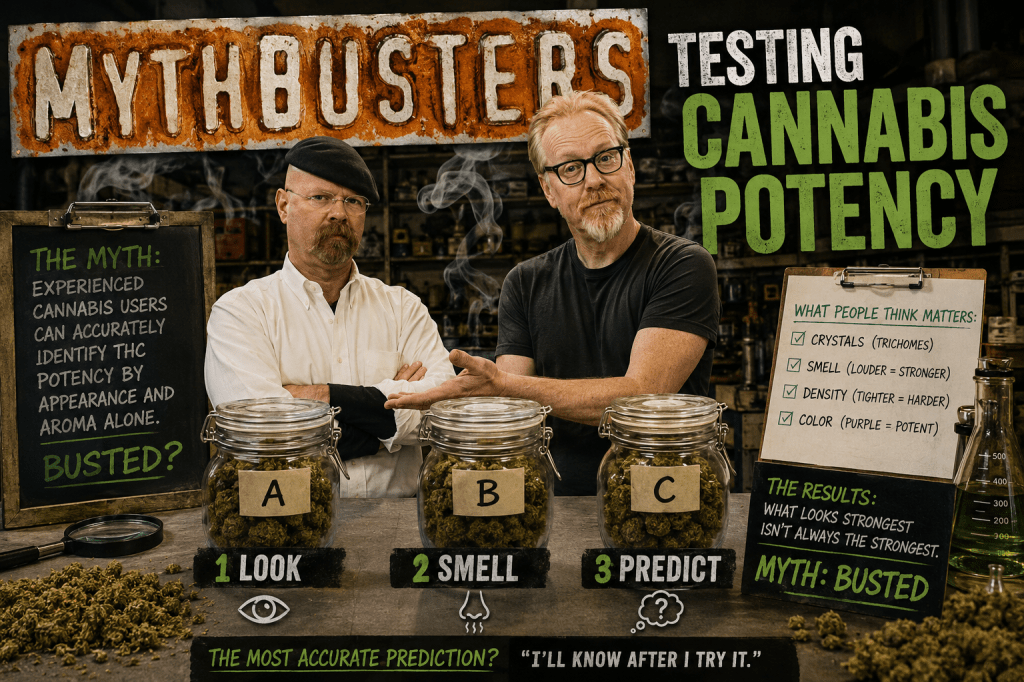
Experienced cannabis users can accurately identify THC potency by appearance and aroma alone.
It sounds believable. People swear by:
• crystals (“more frost = stronger”)
• smell (“louder = more potent”)
• density (“tight buds hit harder”)
• color (“purple means stronger… right?”)
The confidence is always high.
The accuracy?
That’s what we tested.
⸻
The Setup
Three unknown flower samples.
No labels.
No THC percentages.
No branding.
No hints.
Just jars A, B, and C.
Participants were allowed to:
• inspect visually
• smell closely
• examine bud structure
• make potency predictions
No consumption.
No second chances.
Predictions were locked before results.
⸻
Round One: First Impressions
Patterns formed immediately.
Sample A:
Bright, frosty, heavily coated.
“That one’s nuclear.”
Sample B:
Dense structure, loud aroma, visually “premium.”
“That’s top shelf.”
Sample C:
Less flashy. Quieter presence.
“Don’t sleep on that one.”
And just like that, intuition took over.
⸻
What People Think Matters (and Why It Misleads)
Crystals (Trichomes)
More frost is often assumed to mean higher THC.
Reality:
Trichomes matter—but visible density alone doesn’t reliably predict potency.
⸻
Smell
Stronger aroma gets associated with stronger effects.
Reality:
Smell reflects terpenes, freshness, and curing—not THC percentage itself.
⸻
Density
Hard, compact buds are assumed to hit harder.
Reality:
Structure depends heavily on genetics and growing conditions.
⸻
Color
Purple often gets mistaken for strength.
Reality:
Usually genetics or temperature stress responses—not potency.
⸻
Round Two: The Blind Reality Check
Once predictions were locked, things got interesting.
Without labels:
• assumptions stayed strong
• confidence stayed even stronger
• actual accuracy started slipping
Participants correctly identified:
• freshness
• aroma quality
• curing quality
• overall appeal
But THC levels specifically?
Guesses scattered everywhere.
What looked “strongest” wasn’t always strongest.
What looked average sometimes surprised everybody.
And one understated sample quietly outperformed expectations.
⸻
The Reveal
Lab results came in.
The room energy shifted instantly.
• The “obvious winner” wasn’t highest in THC.
• The prettiest sample wasn’t strongest.
• The sleeper jar quietly took the top spot.
It wasn’t random.
But it also wasn’t visually predictable.
⸻
The Real Lesson
This is where the myth breaks cleanly.
People are actually pretty good at identifying:
• freshness
• cure quality
• aroma richness
• overall experience potential
But precise THC percentage?
That’s a completely different layer.
Because cannabis isn’t one variable.
It’s a system:
• cannabinoids
• terpenes
• harvest timing
• curing process
• storage conditions
• individual tolerance
• context
⸻
Final Verdict
MYTH: BUSTED
You can often judge quality with your eyes and nose.
But precise potency?
Not reliably.
And the most accurate prediction in the entire test ended up being the simplest one:
“I’ll know after I try it.”
Turns out that’s not just a joke.
It may be the most scientifically honest answer in the room.
⸻
Closing Note
Cannabis culture loves certainty.
Cannabis itself doesn’t always cooperate.
And maybe that’s the point.
Not everything important can be read from the outside.

