
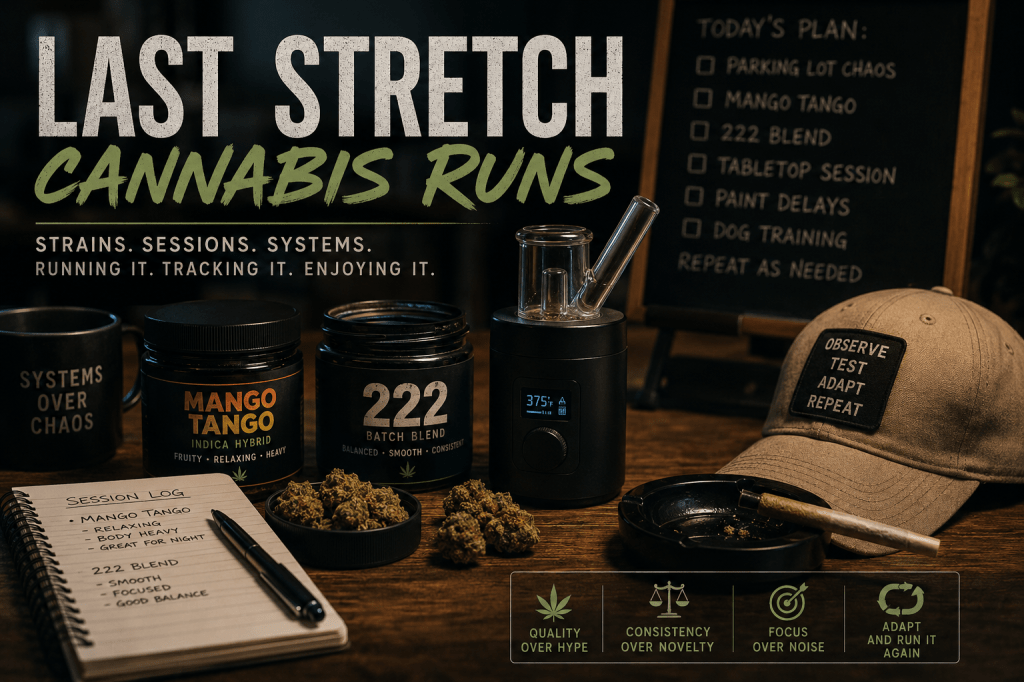
There’s a running theme through the most recent conversations: systems trying to behave, and people adapting when they don’t. From parking lots to terpene profiles to house paint schedules, it’s all the same problem set—just different scales.
The King Soopers Effect: Controlled Chaos in a Grocery Parking Lot
One recurring observation is the King Soopers parking lot phenomenon. Time of day doesn’t matter. Weekday, weekend, morning rush or mid-afternoon lull—it behaves like a system permanently operating at peak load with no scaling plan.
It’s less “parking” and more “collision avoidance with intent.” The real takeaway isn’t frustration—it’s acceptance that some environments are just designed to test patience as a feature, not a bug.
Cannabis Logbook: Strains, Blends, and Consistency Checks
A large portion of recent focus sits in cannabis tracking and strain evaluation—less casual use, more informal quality control.
- Mango Tango came up as a heavy indica-leaning hybrid with fruit-forward terpene complexity and strong physical relaxation effects. The kind of strain that doesn’t ask questions before sitting you down.
- A 222 batch blend entered the rotation, treated like a system test: how it interacts, how it carries, and whether it holds consistency under real-world use conditions.
- Ongoing attention to sourcing and consistency, including attention to grow houses and brand continuity, reflects a preference for reliability over novelty.
There’s a clear pattern: this isn’t just consumption—it’s comparative analysis under lived conditions.
The Vaporizer Layer: Tools, Methods, and Translation Between Systems
Tabletop vaporizers came up as part of a broader technical understanding of delivery systems—bag-style vs tube-style vapor transfer.
The key insight isn’t the device itself, but the translation layer: once you understand one system, the rest tend to follow. That mindset shows up repeatedly—learn one mechanism well enough, and others become variations instead of mysteries.
Domestic Systems: Paint Delays and HOA Reality Checks
House painting delays introduced another familiar system: scheduling friction.
- Medium gray body
- Tan trim
- Burgundy accents
- HOA oversight as the external constraint layer
A delay isn’t just a delay—it’s a reminder that external systems (weather, contractors, HOA rules) always have veto power. Control is partial at best.
Behavioral Engineering: Dogs, Habits, and Feedback Loops
Dog behavior discussion centered on breaking established habits and correcting learned patterns. Whether it’s house training or behavior correction, the core idea remains consistent:
Bad habits persist when the system rewards them—even unintentionally.
Change the feedback loop, and behavior follows. Same principle as any other system, just furrier and more stubborn.
Life Theme Running Underneath Everything
Across all topics—parking lots, cannabis strains, vaporizers, home projects, pet behavior—there’s a consistent operating style:
- Observe systems closely
- Test inputs under real conditions
- Look for consistency over hype
- Accept chaos where control doesn’t exist
- Optimize what actually responds to tuning
It’s not about perfection. It’s about understanding what can be influenced and what can only be navigated.
Closing Snapshot
The throughline in these recent entries isn’t any single topic—it’s the habit of treating everyday life like a set of interacting systems. Some are chemical. Some are social. Some are just asphalt and timing.
All of them behave better once you stop expecting them to behave perfectly.

